Define the Service Before Marketing It A large catering order can appear as straightforward revenue—the kitchen is running, ingredients are on hand, and the check is bigger than a typical table. But catering introduces a different operating model that requires advance preparation to succeed. Catering orders come with fixed delivery deadlines, dozens of meals arriving simultaneously, protective packaging requirements, and customers counting on the food to keep events on schedule—all while the restaurant's dining room still demands attention. The opportunity is not simply to sell more food. It is to build a second operating model that works alongside the first. "Catering available" can mean anything from counter pickup to staffed receptions with equipment rentals. These are not interchangeable offerings. Each requires different staffing, preparation, transportation, and pricing. Before developing packages or reaching out to corporate buyers, operators should decide exactly what the restaurant will provide: pickup orders for groups, scheduled delivery of individually packaged meals, buffet-style delivery with basic setup, or staffed events with service personnel and equipment. A restaurant does not need to offer every format to compete. A focused pickup-and-delivery program may fit its resources better than full-service events.
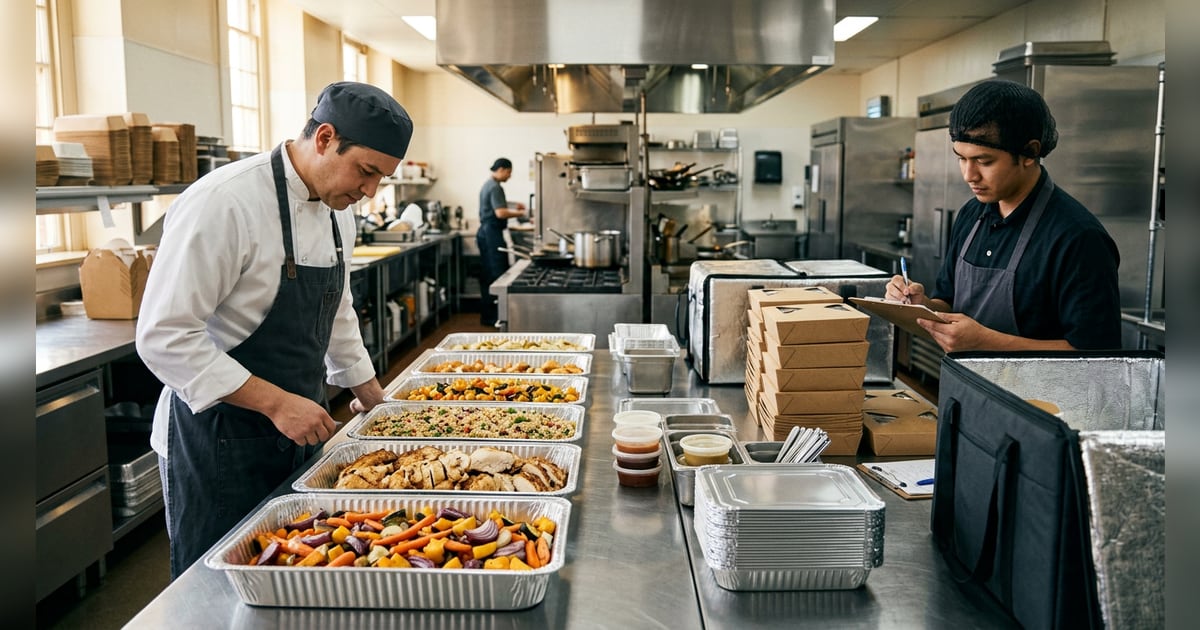
Test Kitchen Capacity Under Compression A kitchen that produces excellent individual meals is not automatically equipped to produce 75 meals for the same departure time. The difference is concentration: during normal service, orders move through the kitchen over time. Catering compresses purchasing, preparation, cooking, assembly, and packing into a single deadline. Operators should walk through an order from beginning to end before accepting it. Where will ingredients be stored? Who will handle advance preparation? Which equipment will be occupied? Where will completed orders wait? Can the delivery team collect the food without blocking the line? Refrigeration, holding equipment, counter space, packaging storage, and loading access all belong in the plan. A useful test is whether the restaurant can stage a complete catering order while continuing to operate normally.
Assign One Person Accountability Catering crosses too many functions to operate on informal handoffs.
The person taking the order may not be the person scheduling production. The kitchen may not know about a delivery change. The driver may arrive without the customer's contact information. Assign one person responsibility for the complete order, from confirmation through follow-up. That does not necessarily require a new full-time position, but it does require clear authority and a backup when the primary lead is unavailable. Every confirmed order should have a shared record covering customer and on-site contact information, guest count and selected menu, dietary requests and allergen information, preparation and packing assignments, delivery address and access instructions, setup expectations and included supplies, and payment status and approved changes.
Design Food for Off-Premises Service A restaurant's best-selling dish is not automatically its best catering product.
The dining room allows a team to control timing and presentation. Off-premises service introduces transportation, holding time, unfamiliar serving spaces, and customers who may not eat immediately. Operators should evaluate food at the point of consumption—not just when it leaves the kitchen. Pack a test order using actual containers. Transport it over a realistic route. Open it after the expected delay and assess temperature, texture, appearance, portion size, and ease of serving. That test may reveal the need to separate sauces, change containers, simplify garnishes, or remove an item altogether. Start with a concise selection of dishes that represent the restaurant and perform reliably. A smaller menu is not a weaker offering when it makes the customer's decision easier and the kitchen's execution more dependable.
Price the Complete Order Catering profitability can disappear in costs that never make it onto the initial worksheet.
Containers, utensils, labels, delivery time, setup labor, payment fees, and third-party charges all affect the result—as does the time spent coordinating an order before production begins. Evaluate each order using a complete cost picture: order revenue minus ingredients, incremental labor, packaging, delivery, setup, and applicable transaction or platform fees. That calculation shows what remains to contribute toward overhead and profit. Set minimums and fees around the work required. A delivery across town has a different cost structure from a customer pickup. A staffed buffet requires more than a tray order. The right pricing structure makes those differences visible rather than asking the restaurant to absorb them.
Establish Operating Boundaries Operators are accustomed to accommodating customers.
In catering, an exception can affect an entire shift. A late order may require an extra purchasing trip. An expanded guest count may exceed holding capacity. A distant delivery may keep a driver away longer than planned. Write down the operating rules before those requests arrive: required lead times, maximum order sizes by production window, available delivery areas, minimum order values, deadlines for guest-count and menu changes, cancellation and payment terms, and limits on substitutions and customization. These define the conditions under which the restaurant can keep its promises. Capacity should be managed by time slot, not just daily order volume. Three orders leaving at noon create a very different challenge from three orders spread throughout the day.
Treat Delivery as Hospitality From the customer's perspective, the experience is not complete when the food leaves the restaurant. It is complete when the correct order arrives, the recipient can locate it, and the meal is ready to serve as promised. Whether delivery is handled internally or through a partner, establish a repeatable process. Verify the destination, identify the recipient, confirm building access, and check every component before departure. Use a packing checklist for food, beverages, serving utensils, plates, napkins, labels, and any promised equipment. Temperature control and appropriate food handling must remain part of the process throughout preparation, holding, transportation, and service. Build procedures around applicable requirements rather than treating insulated bags as a substitute for a food-safety plan.
Launch With a Pilot The first stage should test the system—not the limits of the kitchen.
Begin with manageable orders, a limited menu, and a delivery area the team can serve comfortably. Record what actually happens. Track results consistently: on-time fulfillment, order accuracy, actual labor and packaging costs, customer feedback, repeat orders, and disruption to regular service. Use those findings to adjust pricing, menus, staffing, and delivery boundaries before expanding. Growth should follow evidence that the operation works—not simply enthusiasm for larger orders.
Why It Matters
Catering represents attractive revenue for restaurants, but only when the underlying operation can sustain it. Operators who treat catering as an afterthought risk damaging both the new revenue stream and the core dining business. A methodical approach to defining service, testing capacity, establishing accountability, and pricing comprehensively protects profitability and builds customer trust that translates to repeat orders.
For more insights and trends in the food and beverage sector, check out more articles in The Food & Beverage Magazine family of publications.
Written by FBM Publications Editors