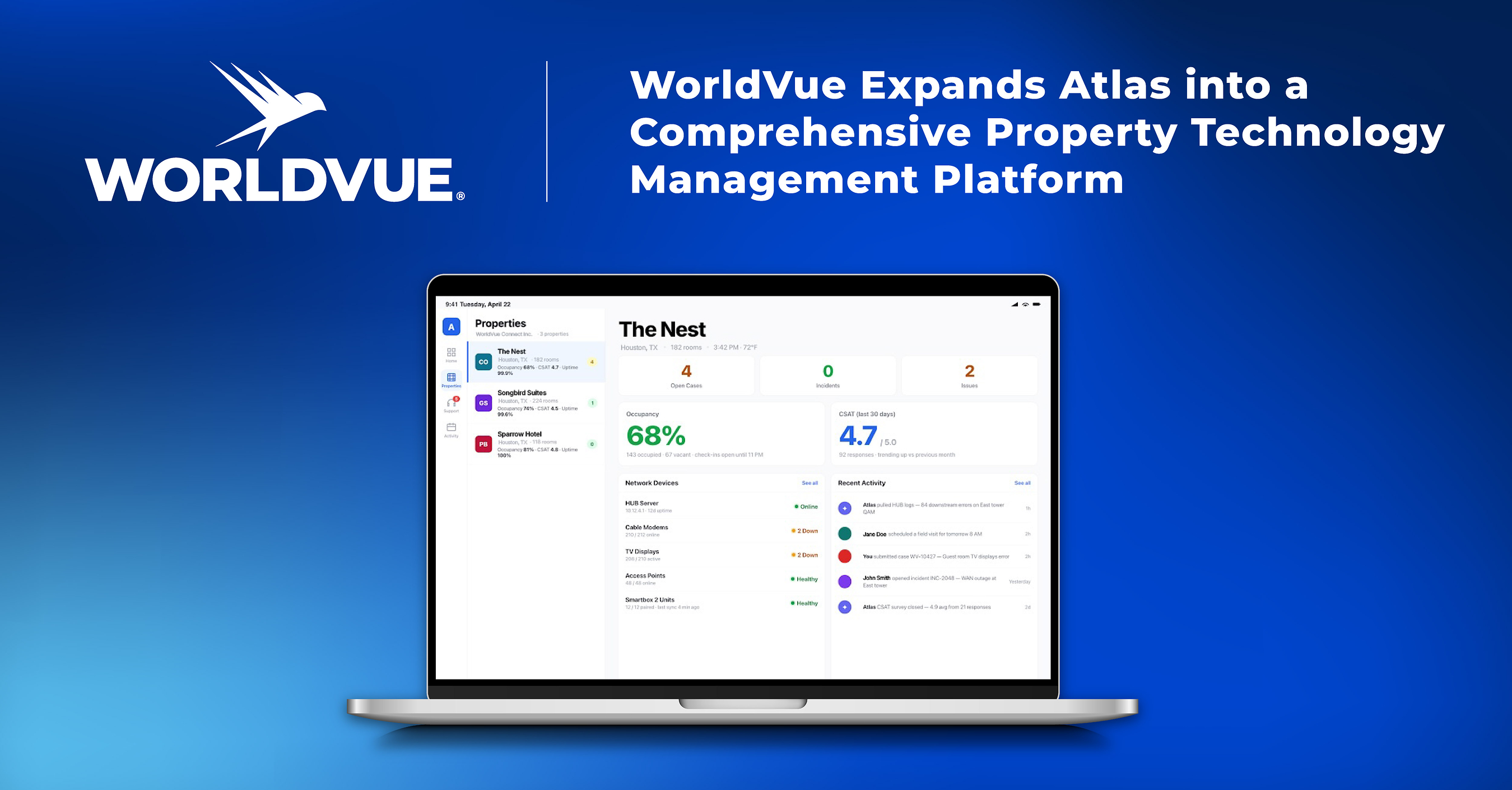
Hotel technology fragmentation — assets scattered across spreadsheets, vendor portals, and siloed systems — is the operational problem WorldVue is betting its expanded Atlas platform can solve. The Houston-based connectivity and managed services provider, which serves more than 8,000 properties and over one million rooms, unveiled a significant evolution of Atlas on October 1, positioning it as a comprehensive property technology management OS rather than a narrow service-visibility tool.
What Atlas Does Now
Atlas currently gives WorldVue customers portfolio and property-level visibility, network monitoring, deployment tracking, and support case management. The expansion broadens that foundation into full technology lifecycle management — and critically, the platform is being designed to work across multiple brands and vendors, not just WorldVue's own services. That vendor-agnostic architecture is a meaningful distinction for hotel owners managing mixed-technology environments across large portfolios.
Modules in development include capital budgeting, contract management, license and subscription tracking, end-of-life equipment identification, and compliance documentation. WorldVue is also adding invoicing directly inside Atlas, so operators can view and pay bills without leaving the platform. "Our goal is to give owners and operators one place to understand what they have, where it is, what needs attention and what's coming next," said Mark Schaps, Executive Vice President and Chief Information Officer at WorldVue.
Field Visibility and AI Support
Two additions address day-to-day operational friction. First, Atlas is expanding real-time field service visibility, allowing property teams to track technician status, estimated arrival times, and work progress. "Property teams want to know more than whether someone has been dispatched," said Niame Ba, Vice President of Operations at WorldVue. "They want visibility into when the technician is arriving, whether work has started and when the issue is resolved."
Second, WorldVue is rolling out MIA, an AI-powered phone agent that collects intake information when a customer calls for support and routes the case with relevant details already attached. The company frames MIA as a friction reducer, not a staff replacement — a nuance that matters as hospitality technology leaders navigate guest and staff expectations around AI deployment.
Why Operators Should Pay Attention
The platform's scope aligns with a broader shift in how full-service and luxury hotels approach technology governance. As properties change ownership or management companies, institutional knowledge about installed systems, contracts, and renewal cycles routinely walks out the door. Atlas's centralized technology record is designed to survive those transitions — a practical value proposition for ownership groups running complex, multi-flag portfolios.
The expansion also reflects growing operator demand for consolidated dashboards that reduce the number of vendor portals staff must navigate. That theme resonates across hotel operations and infrastructure coverage as labor constraints continue to pressure property teams. WorldVue is presenting Atlas at INSPIRE 2026, the International Luxury Hotel Association's flagship North American conference, set for December 15–17, 2026, at JW Marriott Bonnet Creek Resort & Spa in Orlando. Additional Atlas feature tiers are planned for future release.
Written by Michael Politz, Author of Guide to Restaurant Success: The Proven Process for Starting Any Restaurant Business From Scratch to Success (ISBN: 978-1-119-66896-1), Founder of Food & Beverage Magazine, the leading online magazine and resource in the industry. Designer of the Bluetooth logo and recognized in Entrepreneur Magazine's "Top 40 Under 40" for founding American Wholesale Floral, Politz is also the Co-founder of the Proof Awards and the CPG Awards and a partner in numerous consumer brands across the food and beverage sector.