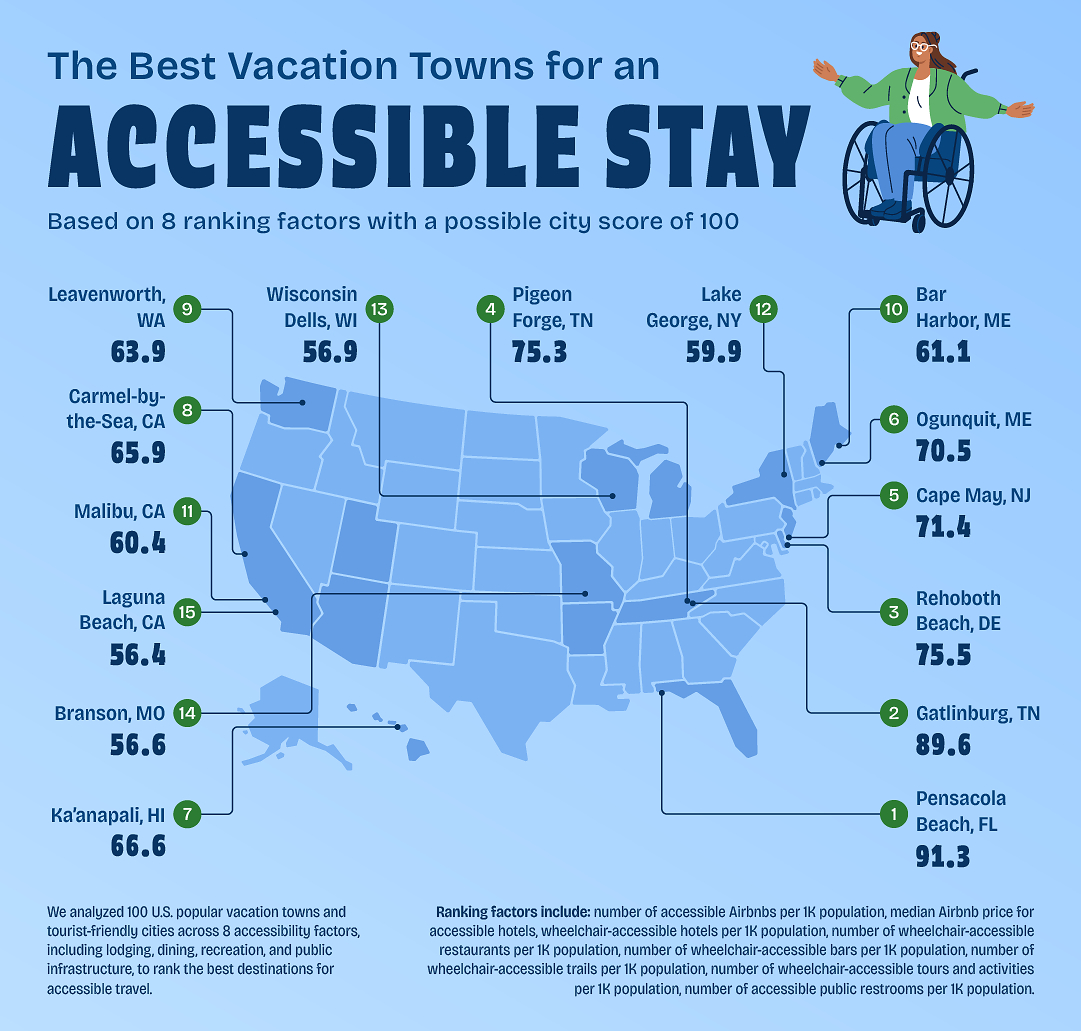
Pensacola Beach, Florida scored highest among 100 U.S. vacation destinations in a new accessible-travel study from Upgraded Points, earning a composite score of 91.3 out of 100. The Gulf Coast market led the field with 64.3 wheelchair-accessible restaurants and 16 accessible public restrooms per 1,000 residents — metrics that carry direct implications for restaurant and hotel operators evaluating location strategy and ADA compliance investments.
The study evaluated beach towns, mountain getaways, resort communities, historic towns, outdoor recreation hubs, and major tourist cities across eight weighted factors: accessible Airbnb availability and pricing, wheelchair-accessible hotels, accessible tours and activities, accessible trails, accessible public restrooms, wheelchair-accessible restaurants, and wheelchair-accessible bars. Availability figures were standardized per 1,000 permanent residents using 2026 population estimates.
The Top-10 Breakdown
Gatlinburg, Tennessee ranked second with a score of 89.6, distinguished by the highest rate of step-free Airbnb listings in the study at 42.4 per 1,000 residents. Rehoboth Beach, Delaware placed third at 75.5 and led more individual factors than any other destination — including 30 accessible hotels and 68.3 wheelchair-accessible restaurants per 1,000 residents. Pigeon Forge, Tennessee (75.3) and Cape May, New Jersey (71.4) rounded out the top five. Ogunquit, Maine ranked sixth and posted 61.9 accessible public restrooms per 1,000 residents, more than twice the rate of any other top-10 finisher. Ka'anapali, Hawaii (66.6), Carmel-by-the-Sea, California (65.9), Leavenworth, Washington (63.9), and Bar Harbor, Maine (61.1) completed the ranking.
Why This Matters for Operators
For foodservice and hospitality operators, the study underscores a market opportunity that remains underserved in many destinations. Accessible dining infrastructure — ramp entrances, step-free seating, accessible restrooms — directly influences which markets attract travelers with mobility needs, and by extension, which restaurants and hotels capture that spend. Rehoboth Beach and Gatlinburg were the only two markets to crack the top five on both the accessible-hotel and step-free-Airbnb lists, signaling that well-rounded accessibility ecosystems, not single-category strength, drive the most traveler confidence.
The lowest median 5-night step-free Airbnb price in the top 10 belonged to Leavenworth, Washington at $1,463, a data point that points to affordability as a differentiator in the accessible-travel segment. Operators in markets that score poorly on dining or lodging accessibility have a competitive gap to close, particularly as accessible hospitality standards gain visibility among travel planners and disability advocacy organizations.
Accessible travel is a growing priority across the broader restaurant and hospitality industry, where operators increasingly face scrutiny over ADA compliance alongside rising demand from aging baby boomers and travelers with disabilities. Studies like this one translate directly into booking behavior, making destination-level accessibility data relevant well beyond the consumer travel context.
Written by Michael Politz, Author of Guide to Restaurant Success: The Proven Process for Starting Any Restaurant Business From Scratch to Success (ISBN: 978-1-119-66896-1), Founder of Food & Beverage Magazine, the leading online magazine and resource in the industry. Designer of the Bluetooth logo and recognized in Entrepreneur Magazine's "Top 40 Under 40" for founding American Wholesale Floral, Politz is also the Co-founder of the Proof Awards and the CPG Awards and a partner in numerous consumer brands across the food and beverage sector.