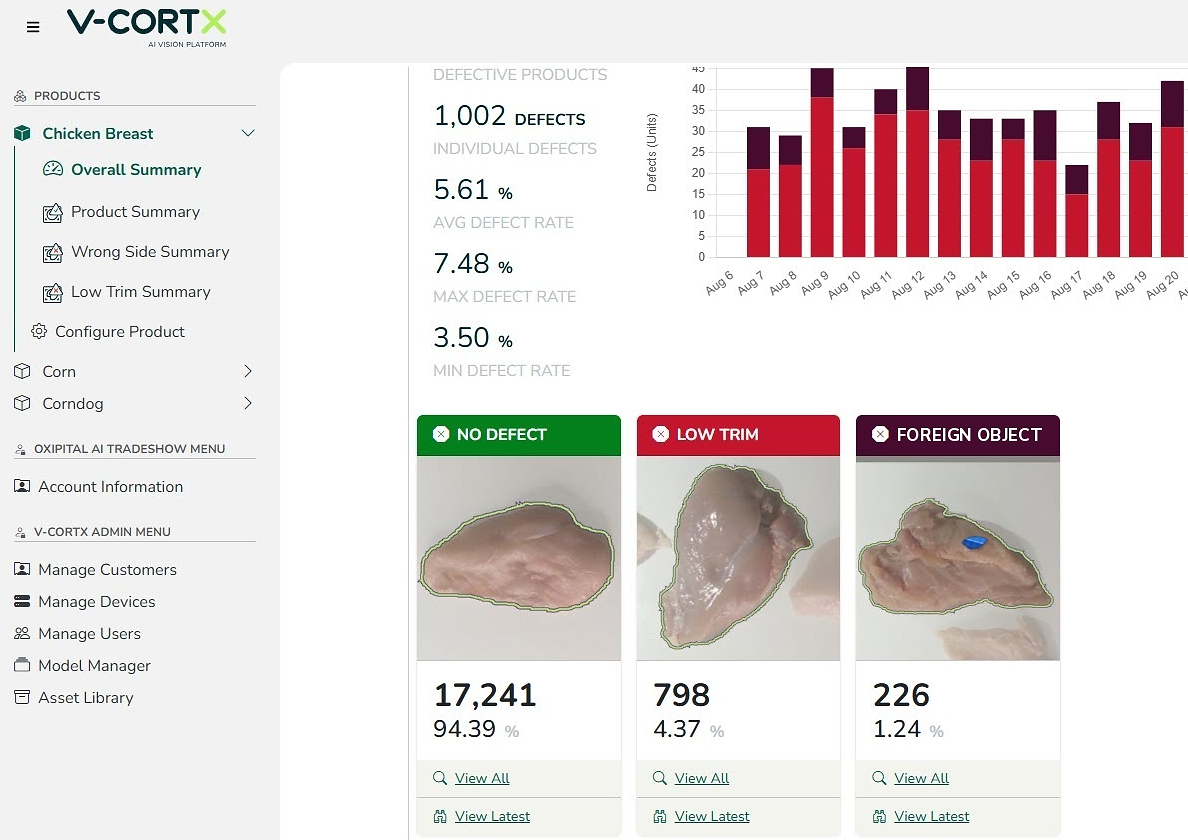
Food manufacturers battling recall risk now have a production-ready AI tool that identifies contaminants in real time without adding a separate hardware platform. Oxipital AI launched its Foreign Material Detection capability this week at Pack Expo, deploying the system on the same OX and VX hardware already used by large food producers for quality inspection and vision-guided robotics.
The company says models are trained to detect hard and soft plastics, wood chips, bone fragments, metal shards, cardboard, and full or partial personal protective equipment — the foreign material categories most frequently linked to recalls and regulatory action. Detection accuracy reaches up to 99% in production environments, per Oxipital AI, with a precision tuning layer designed to minimize false positives that would unnecessarily stop the line.
How the System Works
Rather than waiting for real contamination events to accumulate training data, Oxipital AI uses synthetic data generation to simulate the visual signatures of target contaminants across varied lighting conditions, product types, and line speeds. Models arrive pre-trained and begin inspecting from day one, addressing one of the persistent pain points in deploying machine vision in food manufacturing: long ramp-up periods before a system is reliable enough to trust.
When the system detects a contaminant, it classifies severity and triggers an automated response through its V-CORTX platform, which integrates with existing line control systems. Minor anomalies can slow throughput; high-severity events halt the line without waiting for manual review. The system also identifies contaminant type, giving quality assurance and engineering teams the specificity needed to trace an introduction point — whether a worn line component, a supplier material issue, or a changeover gap.
What Operators Gain
Every detection event is logged automatically in V-CORTX with timestamp, classification, imagery, dimensional data, and throughput impact. That continuous audit trail supports FSQA documentation and root cause analysis — two areas where food manufacturers face mounting pressure from regulators and retail partners alike. For plant managers and corporate engineering teams, a searchable, timestamped record replaces manual logging and supports faster response during audits or investigations.
"Our customers told us they wanted fewer vendors, fewer integration headaches, and more confidence in what their inspection system could catch," said Mark Chiappetta, CEO of Oxipital AI. The single-platform approach — unifying quality inspection, foreign material detection, and vision-guided robotics — reflects a broader industry shift away from point solutions toward integrated food manufacturing technology architectures.
For operators tracking food safety investments, the system's ability to run on hardware already installed in facilities lowers the barrier to adoption significantly. Manufacturers don't need to retrofit lines with new infrastructure; they extend an existing deployment. That model aligns with how large food producers are increasingly approaching food safety and quality automation decisions: consolidating vendors while expanding capability.
Oxipital AI, spun out of Soft Robotics, says the system is already operating on production lines at some of the world's largest food producers. Live demonstrations ran at Pack Expo booth S-3192 October 18–21 in Chicago.
Note: Vision-based inspection can only detect foreign material visible to the camera. Items too small to resolve at operating line speed, or not presented to the camera's field of view, may not be detected.
Written by Michael Politz, Author of Guide to Restaurant Success: The Proven Process for Starting Any Restaurant Business From Scratch to Success (ISBN: 978-1-119-66896-1), Founder of Food & Beverage Magazine, the leading online magazine and resource in the industry. Designer of the Bluetooth logo and recognized in Entrepreneur Magazine's "Top 40 Under 40" for founding American Wholesale Floral, Politz is also the Co-founder of the Proof Awards and the CPG Awards and a partner in numerous consumer brands across the food and beverage sector.