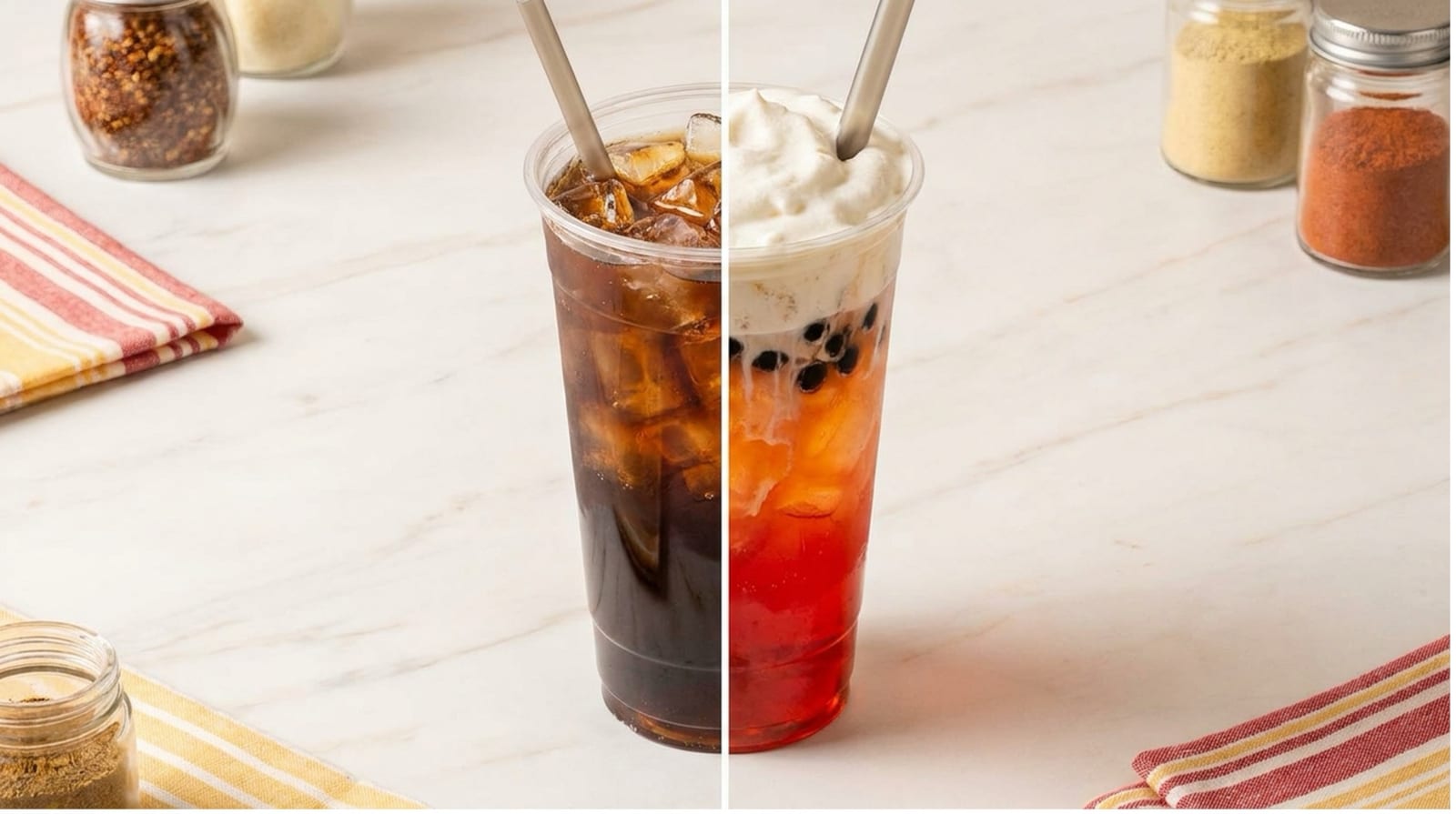
McDonald's Beverage Overhaul Challenges Industry Status Quo McDonald's rollout of six crafted sodas and refreshers across nearly 14,000 U.S. restaurants—including Dirty Dr Pepper with cold foam, Mango Pineapple Refresher with boba pearls, and Red Bull Dragonberry Energizer—marks a decisive break from traditional pouring-rights deals. The move is particularly significant because McDonald's brought in Red Bull for energy despite Coca-Cola holding both an exclusive fountain agreement and a significant stake in Monster Energy. The carve-out signals that even the industry's largest players now view beverage categories as distinct portfolio segments rather than bundled commodities.
The Economics Behind the Shift Crafted beverages are fundamentally changing the profit math.
Standard fountain sodas generate roughly $2.15 in gross profit on a $2.50 sell with 80–90% margins. Dirty sodas priced at $5.50, by contrast, cost only $0.50–$0.90 more in added ingredients (syrups, creams, cold foam, boba) but gross $4.25–$4.75 per unit—nearly doubling profit per serve. The category is scaling rapidly. Dirty sodas currently represent just 2% of menu penetration but are growing at 42% with average pricing of $5.50 and prices climbing 6% quarter over quarter. Consumers now compare these drinks to $6 Starbucks beverages or $8 smoothies rather than fountain pours, shifting willingness-to-pay past $5 and sometimes to $7 or $8.
Industry-Wide Momentum McDonald's is not alone in treating beverage as a primary growth driver.
Taco Bell has set a $5 billion beverage revenue target by 2030 through its Live Más Café concept. Swig, the chain credited with popularizing dirty sodas, grew 46% in 2025 to 146 locations. Major chains are accelerating beverage innovation across their systems.
What the Red Bull Signal Means The real industry signal lies in McDonald's willingness to fragment its supplier relationships. For decades, pouring-rights agreements bundled all beverages under a single supplier. That model worked when "beverage" meant carbonated soft drinks and iced tea. It breaks down when operators want to compete across crafted sodas, energy, functional refreshers, gut-health drinks, and premium non-alcoholic options. No single supplier dominates every category anymore. Coca-Cola controls fountain CSD but lacks leadership in energy, gut health, hydration, or functional refreshers. That fragmentation forces operators to choose: maintain bundled deals for simplicity and rebates, or unbundle categories to access category leaders.
Implications for Multi-Unit Operators Multi-unit operators with 50+ locations should audit their beverage programs now, according to the release. Three specific steps are recommended: Map categories across your portfolio. Document coverage in CSD, energy, functional, hydration, and indulgence tiers. Identify where contract structures limit margin or differentiation. Model the economics of flexibility. Carving out categories means managing multiple direct-store-delivery (DSD) relationships and possibly new equipment, but it also unlocks access to premium-priced brands that drive traffic. Negotiate flexibility into the next agreement. Beverage deals typically run 5–10 years. Contracts signed today should accommodate category expansion and supplier changes expected over their term.
Downstream Pressure on Suppliers McDonald's move creates negotiating leverage for other large operators.
Both Coca-Cola and PepsiCo are responding through acquisition and innovation: PepsiCo acquired Poppi for $1.95 billion, and Coca-Cola launched Simply Pop. The major suppliers are racing to own functional beverage space before competitors fill the gap. Operators positioned to win in this environment will be those who designed beverage programs as category-by-category platforms with partners optimized for each segment, rather than those pursuing the largest rebate from a single supplier.
Why It Matters
The beverage category is no longer an invisible profit generator bundled into fountain contracts.
It's becoming a visible, high-margin growth engine that commands operator attention and supplier innovation. Chains that treat beverage strategy as modular—capable of mixing suppliers, brands, and equipment based on category economics—will capture disproportionate share of the expanding $100 billion beverage category.
For more insights and trends in the food and beverage sector, check out more articles in The Food & Beverage Magazine family of publications.
Written by FBM Publications Editors