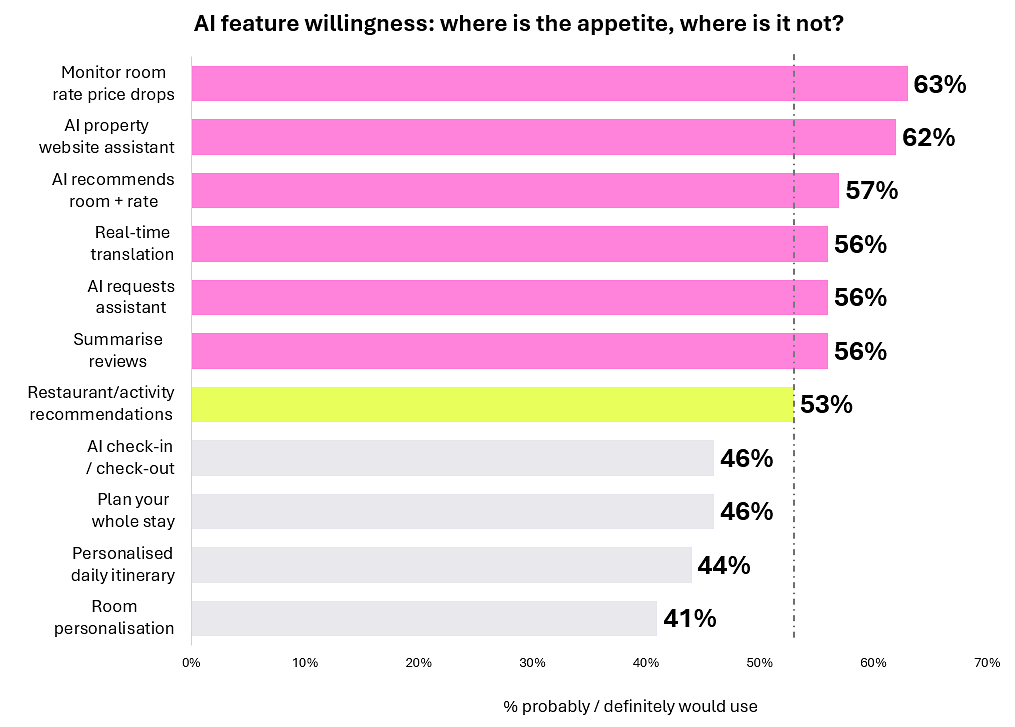
Travelers are willing to let AI monitor hotel room-rate drops and translate conversations in real time, but they draw a hard line when automation moves into personal territory — and the data offers a clear operational signal for hospitality operators.
A new survey of 3,250 travelers from Mews, the hospitality operating system, finds 63% would use AI to track room-rate price drops and 56% would use it for real-time translation. Yet willingness drops sharply when AI moves closer to the guest experience itself: only 44% want AI planning their itinerary, and just 41% would let it personalize their room. The dividing line, the research suggests, is whether a task feels like a chore to be automated or a choice to be made. Fifty-seven percent of respondents said they would rather stay in control of their trip than hand decisions to an AI acting on their behalf.
Data Source Matters
The survey surfaces an equally important nuance for hotel operators managing guest data strategies: travelers are far more comfortable with AI drawing on information they have knowingly shared than on data passively collected about them. Sixty-one percent are at ease with AI using stated preferences, and 56% are comfortable with past stay history being used. That comfort drops to 43% for online behavioral data and 34% for external or social data. Spain stands out as particularly sensitive to transparency, with 72% of Spanish respondents saying they would be more willing to use AI-enabled services if they had clear control over their data.
For operators investing in hospitality technology and personalization, the finding reframes the personalization conversation: it is not that guests reject tailored experiences, it is that they want those experiences built on what they chose to share, not what was inferred without their knowledge.
Market Variations Worth Watching
The survey, conducted in July 2026 across France, Germany, Italy, the Netherlands, Spain, Sweden, the UK, and the US, reveals notable regional differences that operators with multi-property portfolios should factor into their AI rollout strategies. UK travelers show the most purely functional mindset — they are the least likely to rate personalization during a stay as important, at 30% versus a 40% average across markets. Italy and Spain lean in the opposite direction. Italian travelers are the most likely to expect a completely front-desk-free check-in (58% versus a 42% average) and the most optimistic about AI's role in hospitality five years out (51% versus a 39% average). Spain recorded the most positive overall attitude toward AI at 58%.
In the US, 63% of respondents are comfortable with AI drawing on past stay history — the highest comfort level for that data type across all markets surveyed.
Josef Starýchfojtů, CPTO of Mews, framed the operational takeaway directly: "Guests have told us where AI helps, and where it doesn't. Having clever technology is great, but firstly, we should know whether guests want a task done for them or want to be part of it. Get that wrong and even good AI feels intrusive. We're building for human hospitality: technology handles the mundane, repetitive admin, and hotel teams have more time for their guests."
For hotel operators, the practical implication is straightforward: deploy AI aggressively on back-of-house efficiency and pre-arrival logistics — price intelligence, instant communication, language translation — while preserving human touchpoints for the in-stay moments that shape loyalty and reviews. The survey aligns with broader restaurant and hospitality industry trends around AI adoption showing that consumer acceptance of automation is task-specific, not categorical. Properties that treat AI as a precision tool rather than a wholesale replacement for human service are better positioned to capture both the efficiency gains and the guest satisfaction scores that drive revenue.
Written by Michael Politz, Author of Guide to Restaurant Success: The Proven Process for Starting Any Restaurant Business From Scratch to Success (ISBN: 978-1-119-66896-1), Founder of Food & Beverage Magazine, the leading online magazine and resource in the industry. Designer of the Bluetooth logo and recognized in Entrepreneur Magazine's "Top 40 Under 40" for founding American Wholesale Floral, Politz is also the Co-founder of the Proof Awards and the CPG Awards and a partner in numerous consumer brands across the food and beverage sector.