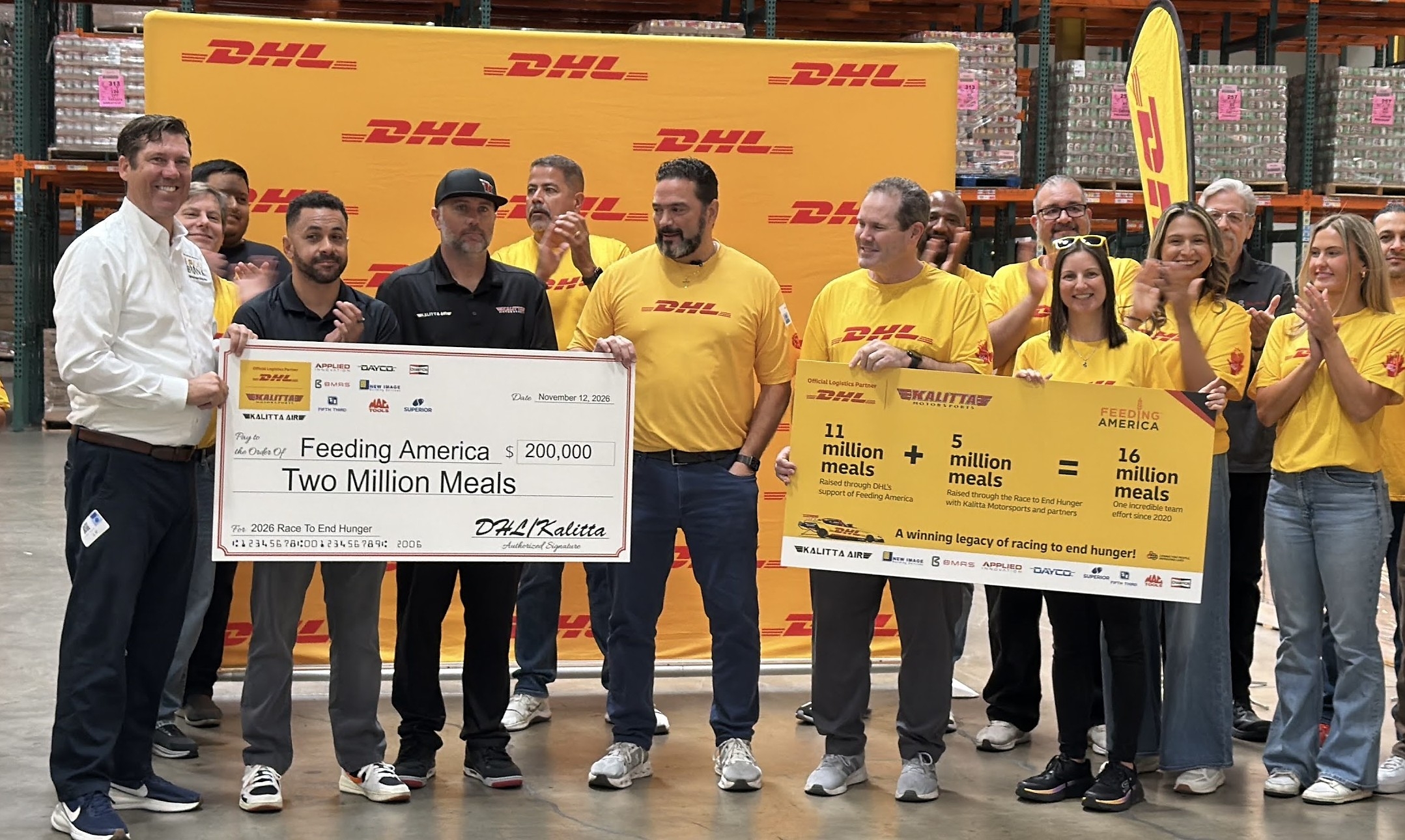
DHL Express has crossed the 16.1 million meal threshold through its Race to End Hunger program, with 2026 efforts alone generating support for more than two million meals — a milestone that underscores both the scale of corporate food-relief partnerships and the persistent depth of hunger in the United States.
The program, run in collaboration with Feeding America, draws on three funding streams: a motorsports-linked giving mechanism, direct employee donations, and company merchandise campaigns. The motorsports component — built around NHRA Mission Foods Drag Racing Series events — saw each race-day win by Kalitta Motorsports drivers Doug Kalitta, J.R. Todd, and Shawn Langdon trigger a combined contribution from DHL, Kalitta Air, Kalitta Motorsports, and eight corporate partners equivalent to 40,000 meals per win light.
The Numbers
In 2026, the Partner On Purpose – Race to End Hunger campaign generated $115,000 in contributions, equivalent to 1.15 million meals, while employee donations and merchandise campaigns added $88,105 — the equivalent of 881,050 more meals. Combined, those efforts cleared the two-million-meal mark for the year and pushed the program's cumulative total to 16.1 million meals since its 2020 launch. Beneficiaries include Feeding America's national network and the Los Angeles Regional Food Bank.
The backdrop is sobering for anyone in the food and foodservice supply chain: Feeding America reports that approximately 48 million people in the U.S. experienced food insecurity in 2024, including more than 14 million children. Rising costs for groceries, housing, and essentials continue to squeeze household budgets, forcing families to make trade-offs between food and other basic needs — a dynamic that sustains demand on food banks well beyond the holiday season.
Why It Matters
For operators and foodservice professionals tracking corporate social responsibility trends in restaurants and hospitality, the Race to End Hunger model offers a replicable template: linking visible brand moments — in this case, motorsports victories — to quantified food-relief outcomes, then layering in employee engagement and retail merchandise to amplify total impact. It also reflects a broader industry recognition that food insecurity is not just a consumer issue but a supply-chain and community-health concern with direct implications for the businesses that feed America.
"Each meal represents hope, dignity and comfort for someone in need," said Nemer Abohasen, VP and General Manager at DHL Express and Head of U.S. Social Responsibility, noting the role of collective employee and partner commitment in making the numbers possible.
Roger Castle, Chief Development Officer of the Los Angeles Regional Food Bank, credited both the financial contributions and the volunteer hours — including time spent sorting and packing food — as meaningful to the organization's ability to serve families across Los Angeles County.
As the food and beverage industry faces continued scrutiny over its role in addressing systemic hunger, programs that convert operational partnerships into measurable community outcomes are drawing increasing attention from both operators and their supply-chain partners. The Race to End Hunger model demonstrates how food-focused corporate giving can be structured around consistent, trackable metrics rather than one-time donations.
Written by Michael Politz, Author of Guide to Restaurant Success: The Proven Process for Starting Any Restaurant Business From Scratch to Success (ISBN: 978-1-119-66896-1), Founder of Food & Beverage Magazine, the leading online magazine and resource in the industry. Designer of the Bluetooth logo and recognized in Entrepreneur Magazine's "Top 40 Under 40" for founding American Wholesale Floral, Politz is also the Co-founder of the Proof Awards and the CPG Awards and a partner in numerous consumer brands across the food and beverage sector.