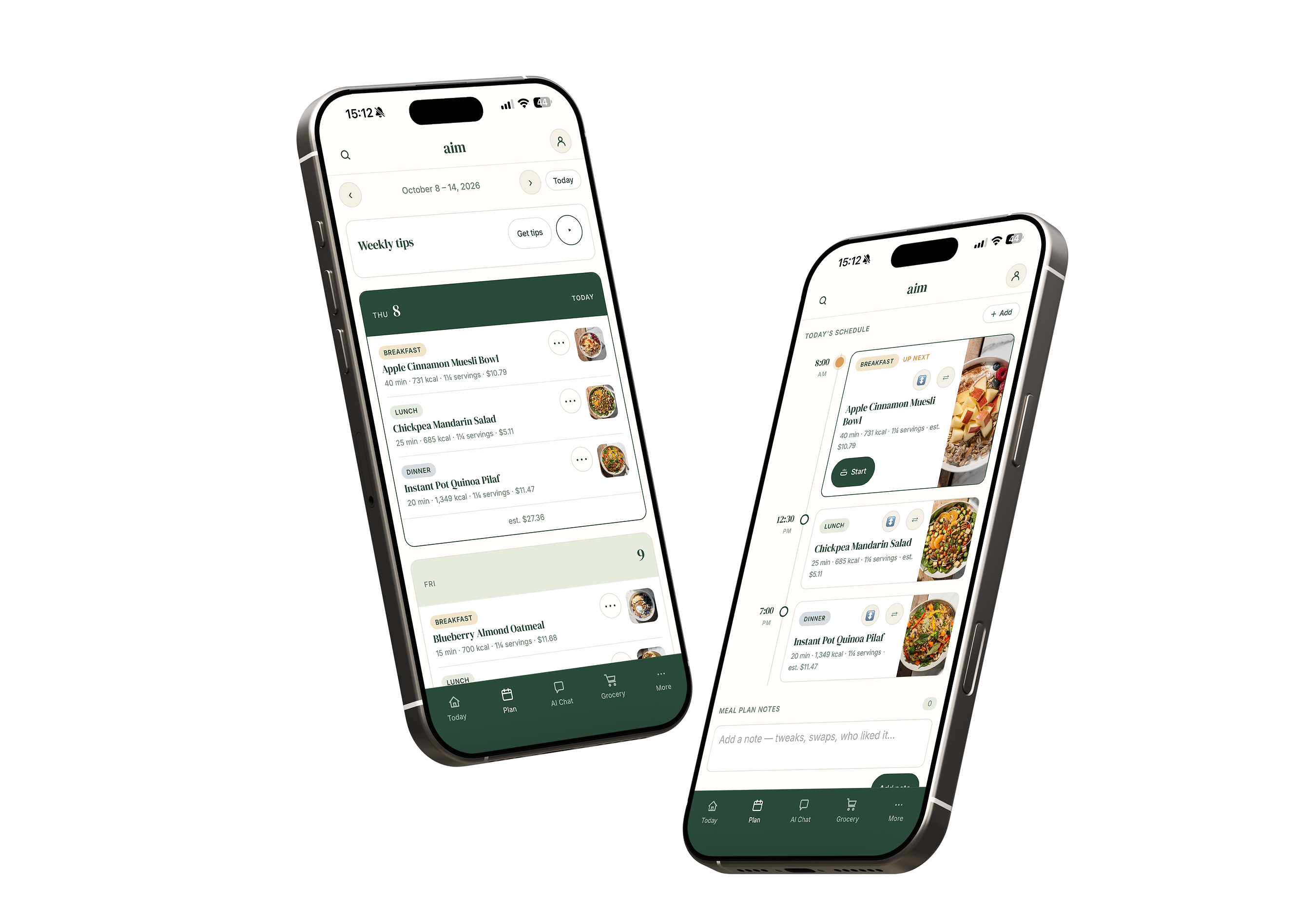
A new AI-powered meal-planning app built around therapeutic nutrition has launched nationwide, entering a consumer food-tech market where personalized dietary guidance is increasingly shaping how families shop, cook, and order food. AI Menu4You (AIM) is now available on iOS and Android, offering households a single platform that generates individualized meal plans, recipes, and grocery lists for every family member simultaneously — regardless of conflicting dietary needs.
The Product at a Glance
The app was founded by Amber Bodily Greenwood, a wellness expert and founder of the Bodily Wellness Institute, who spent two decades working on chronic disease, metabolic health, and nutrition after navigating complex health challenges with her own children. The library behind the app draws on more than 2,800 recipes developed by a team of 12 registered dietitians and sourced from the company's Healing Food Handbook. Users can generate 3-, 5-, 7-, or 21-day meal plans tied to more than 70 health goals — ranging from gut health and immunity support to heart health and stress management.
The platform is engineered to handle overlapping dietary constraints within the same household. A plan can simultaneously accommodate one child avoiding dairy, another on a gluten-free protocol, a parent managing a condition that restricts certain foods, and a grandparent with independent restrictions — all within a single unified output. That multi-profile capability is what differentiates AIM from standard recipe aggregators and positions it squarely in the emerging category of AI-driven personalized nutrition.
Operator and Retail Relevance
For foodservice and grocery operators, the app's downstream effects are worth watching. AIM integrates directly with Instacart for order fulfillment and generates regionally priced grocery lists, creating a data-driven path from meal decision to retail basket. The app also flags recent food recalls and surfaces food-medication interaction alerts — a feature the company encourages users to review with a physician or pharmacist, adding a layer of health credibility that may increase shopper confidence and basket commitment.
The "Having a Bad Day" button — which serves up simplified meal support when full planning feels out of reach — speaks to a consumer insight that operators in the ready-meal, meal-kit, and restaurant delivery segments already know well: friction in home cooking is a conversion opportunity. As AI tools lower the barrier to structured home cooking, operators in those spaces may face users who plan more meals at home in streaks, then rely on foodservice during gaps.
The launch context matters. Bodily Greenwood cited data pointing to roughly 1 in 3 U.S. children living with a chronic disease and childhood obesity currently affecting approximately 20% of American children — up from about 5% in the 1970s. Those numbers have fueled broader consumer interest in functional food and health-forward eating, a trend well-documented across beverage industry analysis and food retail reporting alike. Brands and operators that can credibly align with personalized nutrition are gaining measurable traction with health-conscious households.
What's Next
AIM does not diagnose or treat medical conditions and positions itself explicitly as a nutrition-education and meal-planning tool. Still, its combination of dietitian-developed content, AI personalization, recall monitoring, and commerce integration reflects a maturation in consumer food-tech that is increasingly difficult for retail and foodservice buyers to ignore. As households grow more deliberate about what they put on the table — and turn to AI to manage that complexity — the upstream effects on ingredient sourcing, menu R&D, and retail assortment planning are likely to compound.
Written by Michael Politz, Author of Guide to Restaurant Success: The Proven Process for Starting Any Restaurant Business From Scratch to Success (ISBN: 978-1-119-66896-1), Founder of Food & Beverage Magazine, the leading online magazine and resource in the industry. Designer of the Bluetooth logo and recognized in Entrepreneur Magazine's "Top 40 Under 40" for founding American Wholesale Floral, Politz is also the Co-founder of the Proof Awards and the CPG Awards and a partner in numerous consumer brands across the food and beverage sector.