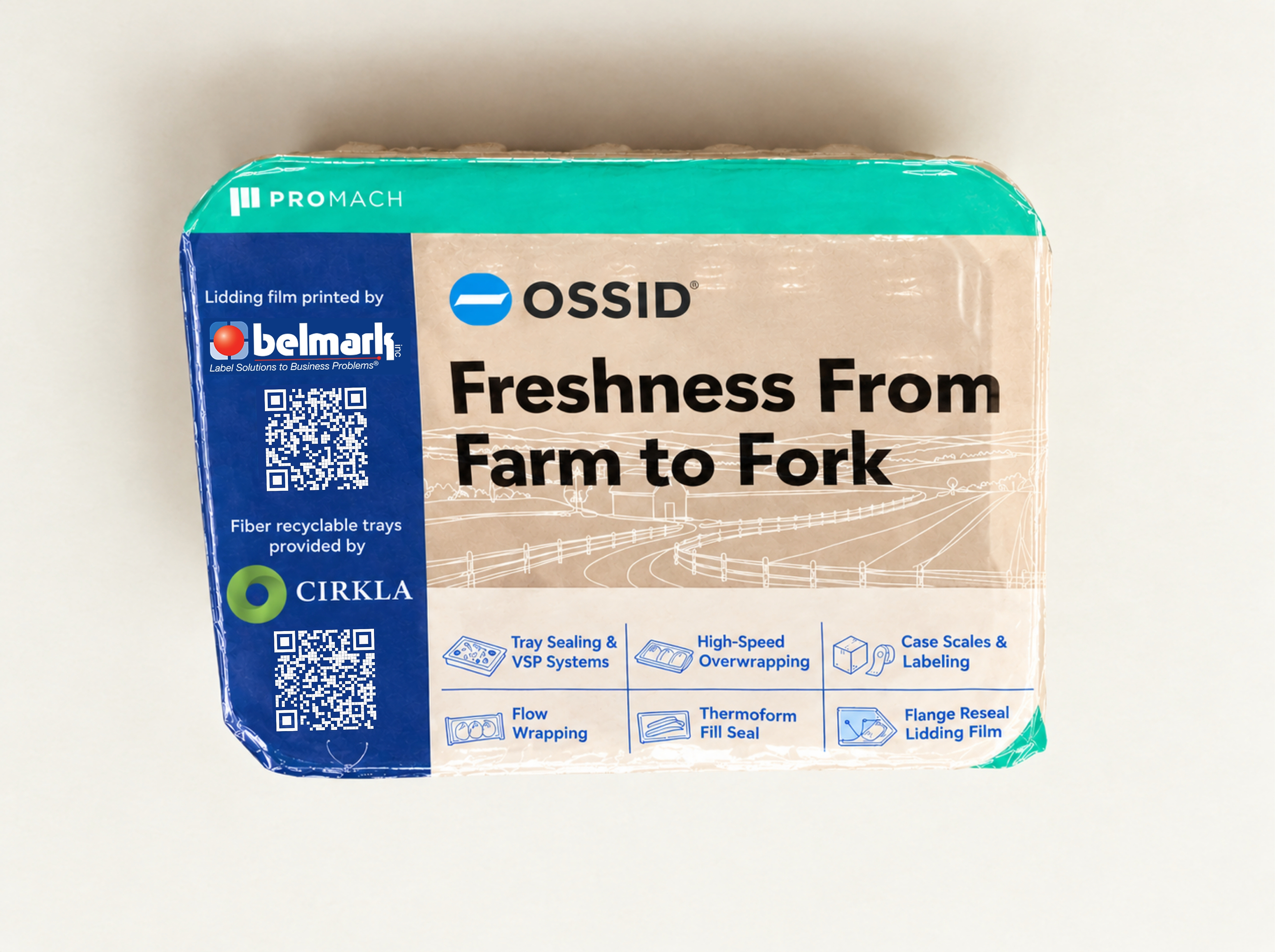
Three packaging specialists have cracked a technical challenge that has kept resealable trays locked to rigid plastic for decades. Cirkla, Belmark, and Ossid jointly debuted the first commercially viable resealable fiber tray system at The Global Produce and Floral Show in Orlando (October 14–16) and Pack Expo in Chicago (October 18–21), targeting fresh protein, produce, and ready-meal applications across foodservice and retail supply chains.
The Technical Breakthrough
The core obstacle—bonding a peel/reseal lidding film to a molded fiber substrate without compromising the tray's interior liner—has historically made fiber an unlikely candidate for resealable packaging. Belmark's advanced lidding film technology, applied to Cirkla's proprietary fiber trays and sealed by Ossid's ReeMaster NextGen Automatic Tray Sealer, resolves that conflict at production scale. The result is a package that supports top-seal, Modified Atmosphere Packaging (MAP), and Vacuum Skin Packaging (VSP) formats—functions previously available only on plastic platforms.
"Resealable fiber packaging has been one of the industry's most sought-after innovations and it took the right partners to make it real," said Glenn Divers, Vice President of Sales at Cirkla. "When you convert a single-use tray into a resealable, multi-use package without compromising performance, cost, or asking brands to change their lines, you remove every reason not to switch."
What Operators and Retailers Gain
For food manufacturers and their retail and foodservice customers, the commercial calculus is straightforward. Cirkla's fiber trays already meet or beat plastic on shelf life, barrier properties, and durability while reducing plastic waste by up to 90%. The company reports the trays are tested and validated on all major tray sealers in the U.S. market—including Ossid equipment—requiring no capital investment or production line changes from processors already running conventional tray sealing.
Ossid's ReeMaster NextGen sealer, purpose-built for medium to large-scale production, features servo-driven indexing conveyors, a stainless steel washdown-ready open-frame design, and a 12-inch color touchscreen with recipe management that simplifies changeovers between packaging styles. That operational flexibility matters for protein processors and produce packers running multiple SKUs on tight schedules.
Cirkla is already proven in production environments with some of the largest retailers and protein processors in the U.S., according to the company. Its first U.S. manufacturing facility, located in Gainesville, Georgia, is set to commence operations in Q1 2027, adding domestic supply chain resilience for brands sourcing sustainable packaging.
Implications for Sustainable Foodservice Packaging
The launch arrives as sustainability mandates from major retail and foodservice buyers continue to accelerate pressure on packaging suppliers to eliminate single-use plastic without sacrificing functionality. Until now, resealability—the consumer convenience feature that drives repurchase behavior and reduces food waste—remained a structural advantage for plastic trays that fiber simply could not replicate.
Jason Vandeloo, Director of Business Development at Belmark, framed the achievement as proof that cross-industry collaboration can unlock solutions that individual companies cannot reach alone: "Bringing resealable functionality to a fiber tray required expertise across materials, film, and equipment, and each partner played an important role."
For operators and buyers tracking sustainable food packaging trends or evaluating alternatives to plastic across their restaurant and foodservice supply chains, this three-way integration represents a meaningful shift in what fiber can credibly deliver at commercial scale. It also signals that the plastic-versus-fiber cost-and-performance debate, long a barrier to adoption, may be entering a new phase—one where the sustainability choice no longer demands a functional trade-off.
Written by Michael Politz, Author of Guide to Restaurant Success: The Proven Process for Starting Any Restaurant Business From Scratch to Success (ISBN: 978-1-119-66896-1), Founder of Food & Beverage Magazine, the leading online magazine and resource in the industry. Designer of the Bluetooth logo and recognized in Entrepreneur Magazine's "Top 40 Under 40" for founding American Wholesale Floral, Politz is also the Co-founder of the Proof Awards and the CPG Awards and a partner in numerous consumer brands across the food and beverage sector.