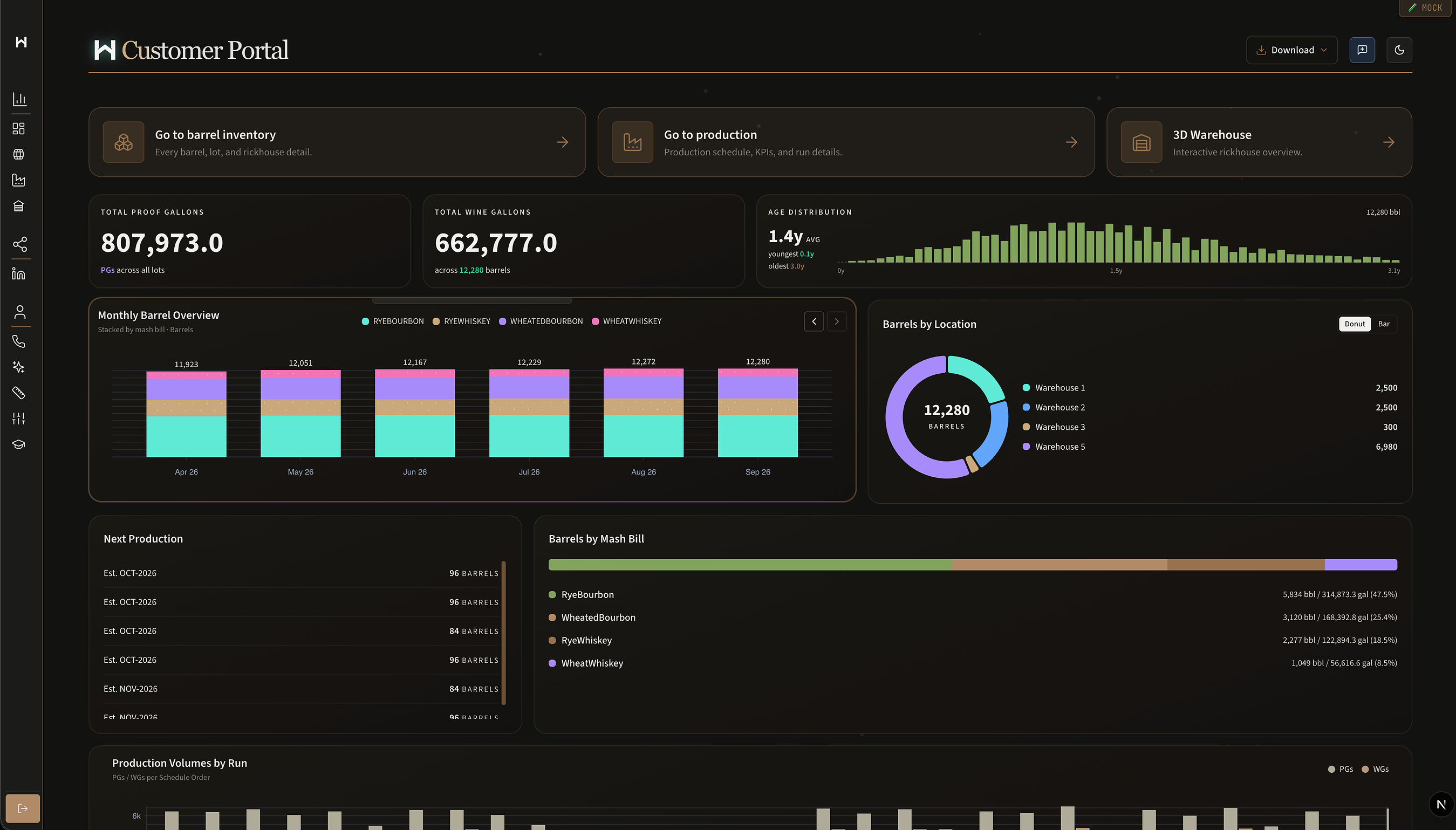
Contract distillery Whiskey House of Kentucky has rolled out Customer Portal 2.0, a ground-up rebuild of its proprietary client platform that gives brand customers a photorealistic, interactive 3D model of the rickhouse where their barrels are aging—alongside live inventory data pulled directly from warehouse and production systems.
The Kentucky-based distillery operates exclusively for branded clients, carrying no house labels of its own, which makes transparency and traceability central to its value proposition. Portal 2.0 formalizes that commitment in software: customers can open the 3D warehouse viewer, filter by lot or schedule order, isolate specific barrels on screen, and retrieve full production records—entry proof, wine gallons, cooperage detail, age, and location—with a single click.
What the Platform Does
Beyond the 3D viewer, the upgrade delivers a card-based customizable dashboard where clients arrange their own inventory and production KPIs, a barrels-by-location visualization, schedule-order analytics, and a one-click branded download menu. Redesigned inventory tiles surface metrics including average wine gallons per barrel, monthly volume, and barrels per rickhouse. Customers can also select their preferred volume unit—liters of pure alcohol, wine gallons, or proof gallons—and every table, chart, and CSV export converts server-side automatically.
"From inception, our goal at Whiskey House was to offer a level of customer service never seen before in this industry," said co-founder and CEO David Mandell. "Our Customer Portal 2.0 further delivers on that promise by providing the most transparent, advanced view any customer has ever had into their production and inventory."
A context-aware guided help feature launches the appropriate walkthrough from any page, and new users are dropped directly into the 3D warehouse on their first sign-in—a detail that reflects how central the viewer is to the overall experience.
Security and Architecture
The platform connects directly to Whiskey House's warehouse and production systems with no middleware layer, eliminating the stale nightly data exports that are common in legacy distillery software. A fail-closed security architecture enforces per-customer data protection on every request, and each account is routed independently, allowing the company to upgrade and migrate individual clients with zero downtime.
"We combined advanced manufacturing, strong systems, and real technical investment to build something that is genuinely useful to our customers every single day," said president, COO, and co-founder John Hargrove. "Customer Portal 2.0 gives the best spirits companies in the world direct, trusted access to their own production—and we will keep investing in it year after year."
For the broader spirits industry, the launch signals where contract production is heading: away from periodic reporting and toward always-on, self-service data access that brand owners expect from other supply-chain partners. As beverage industry investment in distillery technology accelerates, platforms that offer this level of granular traceability are becoming a competitive differentiator for contract producers courting premium and super-premium brand clients. Operators tracking similar transparency moves across food and beverage supply chains can follow related restaurant and hospitality supply-chain coverage for context on how real-time data access is reshaping vendor relationships industry-wide.
Customer Portal 2.0 is available now to all existing Whiskey House customers.
Written by Michael Politz, Author of Guide to Restaurant Success: The Proven Process for Starting Any Restaurant Business From Scratch to Success (ISBN: 978-1-119-66896-1), Founder of Food & Beverage Magazine, the leading online magazine and resource in the industry. Designer of the Bluetooth logo and recognized in Entrepreneur Magazine's "Top 40 Under 40" for founding American Wholesale Floral, Politz is also the Co-founder of the Proof Awards and the CPG Awards and a partner in numerous consumer brands across the food and beverage sector.