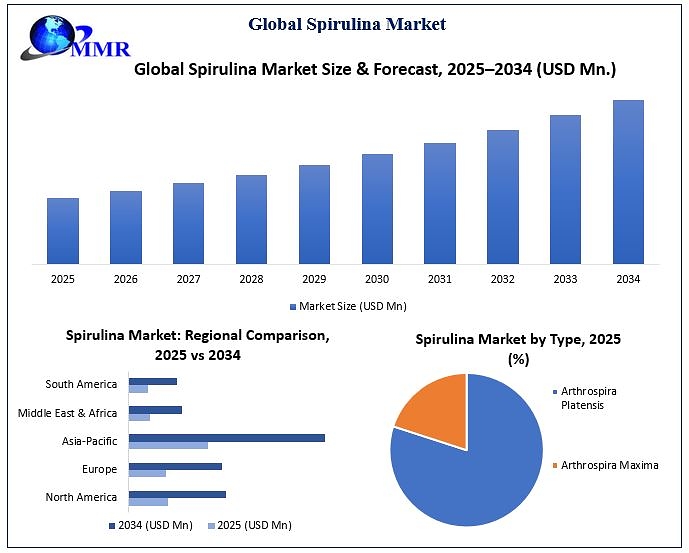
The global spirulina market, valued at USD 651.35 million in 2025, is on track to reach USD 1,612.91 million by 2034 — nearly a 2.5x increase — expanding at a 10.6% compound annual growth rate, according to new research from Maximize Market Research. For food and beverage operators and ingredient buyers, the trajectory signals a maturing supply chain for an ingredient that now straddles protein fortification, clean-label coloring, and functional wellness.
Why Operators Should Take Note
Spirulina's commercial appeal has broadened well beyond the supplement aisle. Demand for phycocyanin — the blue pigment extracted from spirulina — is accelerating across beverage, confectionery, and dairy categories as formulators seek synthetic-dye alternatives in response to tightening regulatory pressure and consumer clean-label expectations. That dual-use profile, as both a high-protein functional ingredient and a natural colorant, is what's drawing broader investment from established ingredient houses and specialty algae producers alike.
North America currently holds the largest regional share of the market, anchored by strong domestic demand for dietary supplements, nutraceuticals, and functional foods. The United States is the primary driver within that bloc, supported by established health-and-wellness retail infrastructure and growing operator interest in traceable, plant-based protein sources. Asia-Pacific, meanwhile, is the fastest-growing region, fueled by large-scale spirulina cultivation in China and expanding food-processing capacity across South Korea, Japan, India, and Indonesia — dynamics that are worth monitoring for beverage and ingredient sourcing trends.
Headwinds for Scale
Despite the growth outlook, operators and procurement teams should weigh meaningful supply-side constraints. Controlled cultivation, harvesting, drying, and contamination-prevention protocols keep spirulina production costs elevated relative to conventional protein sources. Consistency in nutritional composition and pigment concentration also remains a challenge: variations in water quality, light exposure, and processing conditions can shift the ingredient's functional and visual performance batch to batch. Those quality-control requirements make supplier vetting particularly important for brands building clean-label or color-critical applications.
Technology investment is beginning to address those limitations. Photobioreactor systems, AI-enabled cultivation monitoring, and automated biomass assessment are improving production efficiency and scalability. Several producers are also expanding into high-value phycocyanin extraction as a way to diversify revenue and justify the cost structure of precision cultivation. For restaurant and foodservice operators tracking functional ingredient sourcing, these technology shifts could translate into improved price stability and more consistent supply over the forecast period.
Key producers shaping the competitive landscape include Cyanotech Corporation, DIC Corporation, Parry Nutraceuticals, Earthrise Nutritionals LLC, GNT Group, Roquette Frères, and Givaudan, alongside a growing cohort of Asian biomass producers. Competition centers on cultivation efficiency, phycocyanin extraction capability, and the ability to meet organic and traceability standards increasingly demanded by food and beverage brand owners.
Written by Michael Politz, Author of Guide to Restaurant Success: The Proven Process for Starting Any Restaurant Business From Scratch to Success (ISBN: 978-1-119-66896-1), Founder of Food & Beverage Magazine, the leading online magazine and resource in the industry. Designer of the Bluetooth logo and recognized in Entrepreneur Magazine's "Top 40 Under 40" for founding American Wholesale Floral, Politz is also the Co-founder of the Proof Awards and the CPG Awards and a partner in numerous consumer brands across the food and beverage sector.