Commercial kitchen procurement has outgrown the simple equipment-purchase model. Shinelong, the Guangzhou-based kitchen equipment manufacturer founded in 2008, is formalizing that reality by codifying its field-tested approach into a structured, repeatable project management system — one it says is designed to handle the regulatory patchwork, infrastructure gaps, and operational variables that complicate cross-border foodservice builds.
The company reports more than 8,000 completed projects spanning over 150 countries and regions, with a client mix ranging from star-rated hotels and fine-dining restaurants to hospitals, fast-food chains, and institutional bakeries. That breadth of experience is now being translated into a documented delivery framework that covers the full project arc: initial consultation, spatial planning via CAD and AR visualization, equipment selection, manufacturing, international logistics, on-site installation and commissioning, staff training, and after-sales support.
Regional Compliance as a Differentiator
For operators and procurement teams evaluating global kitchen suppliers, regulatory alignment is often the most time-consuming hurdle. Shinelong positions its regional compliance layer as a core part of the offer rather than an afterthought. European projects must clear CE marking, RoHS environmental directives, and HACCP food-safety requirements alongside local building and MEP codes. North American projects introduce NSF/ANSI, UL/ETL, and FDA food regulations. Emerging markets in Africa and the Caribbean present a different set of challenges: infrastructure variability, limited local trade capacity, and demand for high-throughput equipment suited to large-scale, centralized meal production.
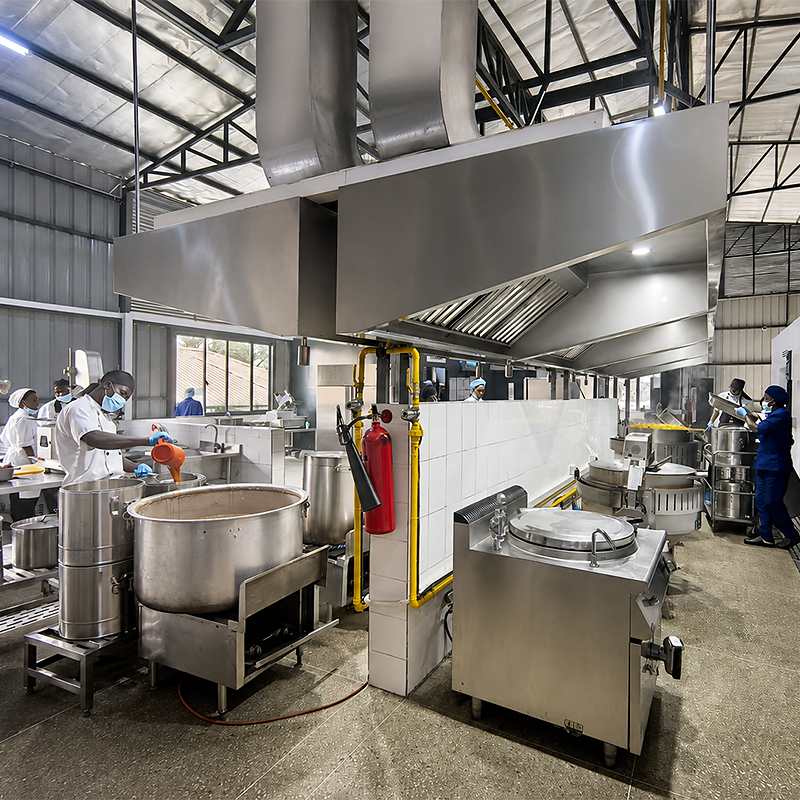
The company points to three recent international projects as proof of the model's flexibility. At the Radisson Resort & Suites Phuket in Thailand, space constraints and Thai health and safety codes required a custom 304 stainless steel structure paired with MEP ventilation design and German core components — resulting in what Shinelong describes as a scalable, future-ready kitchen system aligned with international chain-brand standards. At the University of Kigali Teaching Hospital in Rwanda, the challenge was high-volume centralized meal preparation for a large medical institution, requiring careful functional zoning to support consistent, nutritious daily output. Closer to its home market, an Iraqi restaurant in Guangzhou called for an island kitchen layout specifically engineered around the cooking processes and workflow of Iraqi cuisine — illustrating that localization applies even within a single city.
Implications for Global Operators
The shift Shinelong is describing — from equipment vendor to full-scope project partner — reflects a broader evolution in commercial kitchen procurement and design that foodservice operators and hospitality developers are increasingly demanding. As hotel groups, healthcare systems, and restaurant chains expand across borders, the administrative burden of managing separate equipment, engineering, logistics, and installation contractors grows substantially. Consolidated delivery accountability, when it works, reduces that friction.
Founder Jean Yang framed the company's ambition plainly: "Global project delivery requires both consistency and adaptability. In the future, we hope to continue transforming our accumulated project experience into more mature processes, while maintaining our adaptation ability for different markets and customer needs, so as to provide global customers with more reliable and flexible commercial kitchen project solutions."
For procurement directors and project managers in hospitality and institutional foodservice, the practical implication is that a manufacturer's geographic reach and its compliance depth are becoming as important as equipment specification sheets. Coverage of global foodservice equipment and supply-chain trends continues to show that operators are placing greater weight on vendors that can demonstrate end-to-end accountability — a standard Shinelong is explicitly benchmarking itself against as it pursues further international growth.
Written by Michael Politz, Author of Guide to Restaurant Success: The Proven Process for Starting Any Restaurant Business From Scratch to Success (ISBN: 978-1-119-66896-1), Founder of Food & Beverage Magazine, the leading online magazine and resource in the industry. Designer of the Bluetooth logo and recognized in Entrepreneur Magazine's "Top 40 Under 40" for founding American Wholesale Floral, Politz is also the Co-founder of the Proof Awards and the CPG Awards and a partner in numerous consumer brands across the food and beverage sector.