The Attention Economy Has Rewritten Restaurant Competition Restaurant operators think they're in the food business.
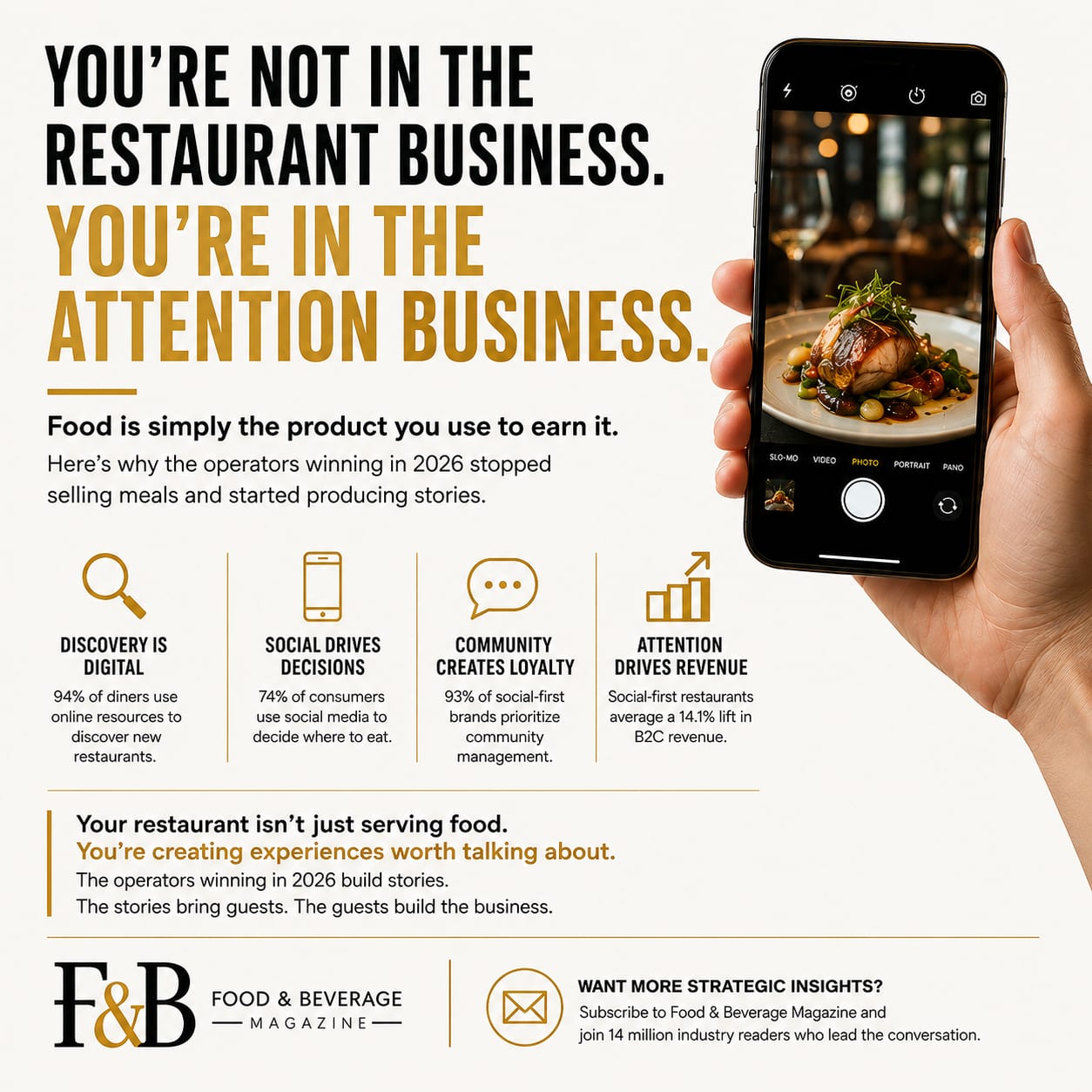
Industry data suggests they're actually competing in the attention business—and most are losing. The shift is stark: 94% of diners use online resources like Google, social media, and review sites to discover restaurants. For Gen Z, 69% rely on social media as their primary discovery channel. Yet 99% of full-service restaurants maintain active social profiles, compared to only 69% with functional websites, meaning Instagram is often a guest's first impression. The payoff is measurable. In 2024, restaurants reported an average 9.9% lift in revenue directly attributed to social strategy. "Social-first" brands—operators treating content as a core function—posted a 14.1% average lift (Deloitte Digital).
## Why Discovery Has Left the Dining Room Twenty years ago, a good location, recognizable sign, solid menu, and attentive service could sustain a restaurant. Today, guest attention spans have contracted from 12 seconds to roughly 8.25 seconds, with Gen Z closer to 6-8 seconds. A potential customer wakes to hundreds of notifications, thousands of posts, and an endless content queue. Good food is no longer enough—it never was. It was simply easier to capture attention before everyone else was competing for it. Data from SevenRooms, Restaurant Velocity, and Deloitte Digital shows that: - 74% of consumers use social media to decide where to eat
- 93% of diners check Google, Instagram, or Facebook before choosing a restaurant
- 65% of consumers follow food and lifestyle topics on social media—the largest interest community surveyed
- 83% of diners are willing to sign up for restaurant marketing programs if they expect VIP treatment beyond discounts
Restaurants as Media Companies Whether intentional or not, every restaurant is already a media company.
Guests film plates. Servers post shifts. Reviewers screenshot menus. The question is whether operators direct that narrative or let it happen to them. Operators pulling ahead have internalized four principles: - Every special tells a story before it's a menu item
- Every team member is on-camera talent whose personality competitors can't copy
- Every guest interaction creates a story that either gets shared or doesn't
- Every social post either reinforces identity or dilutes it—there is no neutral post Community management matters more than follower count. 93% of social-first restaurant brands rank community management as high or very-high priority, versus only 63% of less-savvy operators. Replies, direct messages, and comments are the new front-of-house.
The Operating Framework Top-performing independent restaurants are reorganizing around attention without burning out teams. The framework includes: Treat content as a station. Assign it. Schedule it. One manager or team member per shift responsible for capturing 3–5 pieces of raw content turns an ad-hoc habit into a 20-minute line item with no food cost. Build a story bank, not a calendar. A living archive of dish origins, ingredient sourcing, staff bios, frequently asked questions, and signature moments yields 60+ posts that can rotate and remix indefinitely. Own the direct relationship. Email and SMS lists are the only audiences algorithms can't remove. Build them with the same care as a wine list. Measure attention alongside covers. Track saves, shares, profile visits, and reservation clicks. Attention metrics are leading indicators; cover counts are lagging ones. Show up where decisions are made. For guests under 45, short-form video dominates. For older demographics, Google reviews and word-of-mouth still drive decisions. A modern marketing stack must serve both.
Why It Matters
The restaurant sector hasn't become harder because cooking became harder.
It's become harder because capturing attention became harder—and most independents still operate with a 2005 marketing playbook. The operators winning aren't necessarily the best cooks in their market. They're the ones who realized their real product is a reason to be talked about. Food is the delivery mechanism, not the destination.
For more insights and trends in the food and beverage sector, check out more articles in The Food & Beverage Magazine family of publications.
Written by FBM Publications Editors