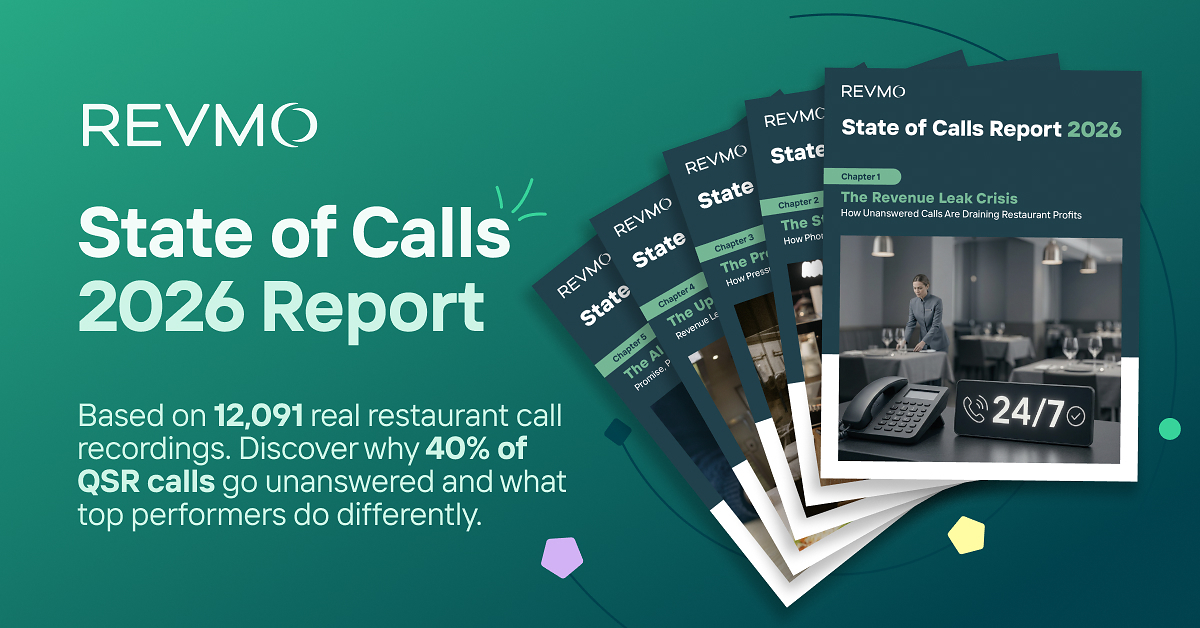
Restaurant operators are leaving billions of dollars on the table — not from empty seats or slow ticket times, but from unanswered phones. A new report from Revmo AI, based on analysis of 12,091 actual call recordings across QSR, fast casual, full-service, and pizza segments, puts hard numbers on a problem that most multi-unit operators have long suspected but rarely quantified.
The State of Restaurant Calls 2026 is the most comprehensive benchmark study of restaurant phone performance published to date. Its findings expose wide gaps in answer rates, greeting consistency, wait times, and upsell execution — gaps that compound significantly at scale.
Segment-by-Segment Breakdown
QSRs posted the worst answer rate in the study at just 59.9%, meaning roughly four in ten incoming calls go unanswered. The report estimates that translates to $73,000 in annual revenue lost per location from missed calls alone — a figure that grows to $3.65 million annually across a 50-unit chain. Fast casual operators answered 75.3% of calls overall, but the segment showed a dramatic 38-point collapse in greeting consistency between lunch and dinner dayparts, with wait times rising 31% as dinner volume peaked. The data suggests fast casual kitchens are particularly vulnerable during high-demand windows when staffing is stretched thin.
Full-service restaurants led on answer rates at 91.0% but still showed concerning inconsistency in brand execution. Greeting consistency across the FSR segment averaged 76.6%, though individual brand performance swung wildly — from a 99.2% greeting rate at Morton's to just 27.5% at Golden Corral. Average hold times for FSR customers reached 73 seconds. Pizza operations posted the best answer rate at 93.1%, but the segment left revenue on the table in a different way: only 28.6% of calls included any upsell attempt for sides or add-ons, despite pizza restaurants leading the industry in promotion mentions at 75.6%.
Where AI Changes the Math
The report's final chapter evaluates AI phone agents and finds that implementation quality is the decisive variable. Poorly configured AI systems actually underperformed human staff, scoring 3.30 on sentiment versus 3.90 for human-answered calls. Well-configured AI systems, however, exceeded human benchmarks on every measured metric — achieving sentiment scores above 4.2, wait times of 18 to 22 seconds, and 100% greeting consistency.
"AI's greatest value is not only labor savings but also eliminating execution noise," said Ryan Louis, CEO of Revmo AI. "If AI ensures a 100% promotion mention rate, you can finally test offers objectively without wondering if staff mentioned them."
That point resonates with operators who have struggled to run reliable A/B tests on limited-time offers or new menu items when front-of-house staff execution is inconsistent. David Rev Ciancio, CMO of Salad House and Handcraft Burgers, framed the practical case directly: pulling a team member off the floor to answer a question about closing time is a real trade-off, and one that AI can eliminate without sacrificing guest experience.
What Operators Should Do Next
For restaurant technology decision-makers, the report functions as a competitive benchmark. Operators can compare their own phone answer rates, hold times, and upsell consistency against segment averages — and quantify the revenue impact of closing those gaps. Revmo has also published a free revenue leak calculator on its site to help multi-unit groups model the cost of missed calls at their specific location count.
The findings align with broader foodservice industry trends around AI adoption, where the conversation has shifted from whether to deploy AI tools to how to configure them for measurable performance gains. The Revmo data suggests that deployment quality — not just the technology itself — is what separates operators who benefit from those who don't. The full report methodology covers 224 AI-answered calls and 9,187 human-answered calls, evaluated across multiple time zones, dayparts, and seasonal periods.
Written by Michael Politz, Author of Guide to Restaurant Success: The Proven Process for Starting Any Restaurant Business From Scratch to Success (ISBN: 978-1-119-66896-1), Founder of Food & Beverage Magazine, the leading online magazine and resource in the industry. Designer of the Bluetooth logo and recognized in Entrepreneur Magazine's "Top 40 Under 40" for founding American Wholesale Floral, Politz is also the Co-founder of the Proof Awards and the CPG Awards and a partner in numerous consumer brands across the food and beverage sector.