St. Louis-based Post Holdings closed its fiscal year ended September 30, 2026, with net sales of $8.12 billion and Adjusted EBITDA of $1.57 billion — a 2.0% year-over-year improvement in operating earnings — signaling durable margin gains even as the company worked through two significant divestitures and softening demand in key consumer categories.
For foodservice operators and supply chain professionals, the results carry direct implications: Post's egg and potato-products Foodservice segment generated $2.58 billion in fiscal 2026 net sales, and the company confirmed it will continue investing in cage-free egg facility expansion in the year ahead. Capital expenditures for fiscal 2027 are expected to range between $360 million and $400 million, with cage-free infrastructure and nut butter manufacturing optimization as the two named priorities — a signal that egg supply and pricing dynamics will remain central to Post's foodservice strategy.
Foodservice Segment in Focus
The Foodservice segment — which supplies eggs and potato products to restaurant and institutional channels — saw fourth-quarter net sales decline 11.5% to $635.2 million compared to the prior year period, with volumes down 2.6%. Management attributed the quarterly pullback largely to the absence of the avian influenza-driven pricing premiums that had inflated year-ago figures, rather than fundamental demand erosion. For the full fiscal year, Foodservice segment Adjusted EBITDA rose 4.5% to $556.8 million, underscoring the unit's underlying profitability once one-time pricing dynamics are stripped out. Operators who locked in egg contracts during the prior avian influenza cycle should note that normalized pricing is now reflected in Post's cost structure and guidance.
Consumer Brands Headwinds
Post Consumer Brands — which covers North American ready-to-eat cereal, granola, pet food, and nut butters — recorded full-year net sales of $4.11 billion, up 2.2%, but faced volume pressure in the fourth quarter. Pet food volumes fell 12.7% in Q4, driven by distribution losses and category softness, while cereal and granola volumes declined 4.4% on category weakness and value-tier distribution losses. Those trends matter beyond the retail shelf: private label dynamics in center-store categories often telegraph consumer trade-down behavior that ripples into foodservice traffic patterns, a factor worth monitoring in food and beverage industry analysis.
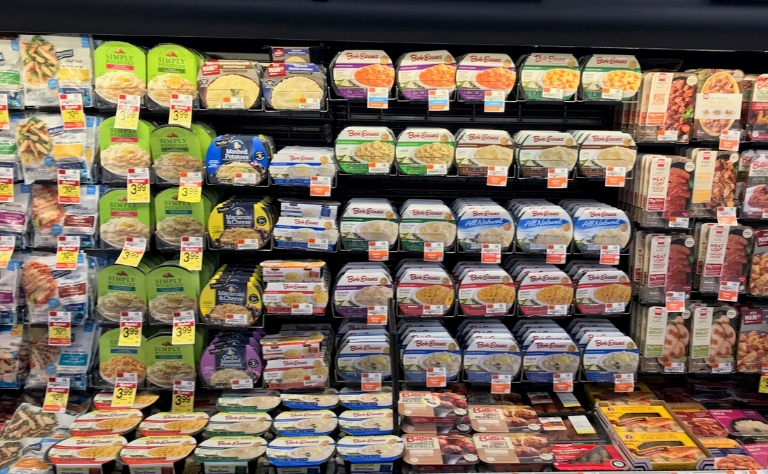
The Refrigerated Retail segment, which houses side dish, egg, and sausage products, posted full-year net sales of $873.8 million, down 8.3%, primarily reflecting the May 2026 divestiture of Crystal Farms Dairy Company. Excluding that divestiture, the segment's underlying volumes were actually positive: side dish volumes grew 4.7% and egg volumes rose 4.4% in the fourth quarter, offset by a 12.7% sausage volume decline. The UK Weetabix segment delivered a bright spot, with full-year segment Adjusted EBITDA climbing 11.6% to $138.1 million.
FY2027 Outlook
Management guided fiscal 2027 Adjusted EBITDA to a range of $1.45 billion to $1.5 billion — below the fiscal 2026 result of $1.57 billion — reflecting the absence of the divested businesses and continued investment spending. The company repurchased 10.3 million shares in fiscal 2026 for $1.009 billion, and as of mid-November 2026 had $396.7 million remaining under its repurchase authorization. Net leverage under Post's credit agreement stood at 4.7x as of September 30, 2026.
For restaurant and foodservice buyers, the clearest near-term read is that Post's continued cage-free capex commitment — maintained even amid a softer earnings outlook — reinforces the structural shift underway in commercial egg supply, with availability and cost implications that extend well into the planning horizon for restaurant operators navigating ingredient sourcing.
Written by Michael Politz, Author of Guide to Restaurant Success: The Proven Process for Starting Any Restaurant Business From Scratch to Success (ISBN: 978-1-119-66896-1), Founder of Food & Beverage Magazine, the leading online magazine and resource in the industry. Designer of the Bluetooth logo and recognized in Entrepreneur Magazine's "Top 40 Under 40" for founding American Wholesale Floral, Politz is also the Co-founder of the Proof Awards and the CPG Awards and a partner in numerous consumer brands across the food and beverage sector.