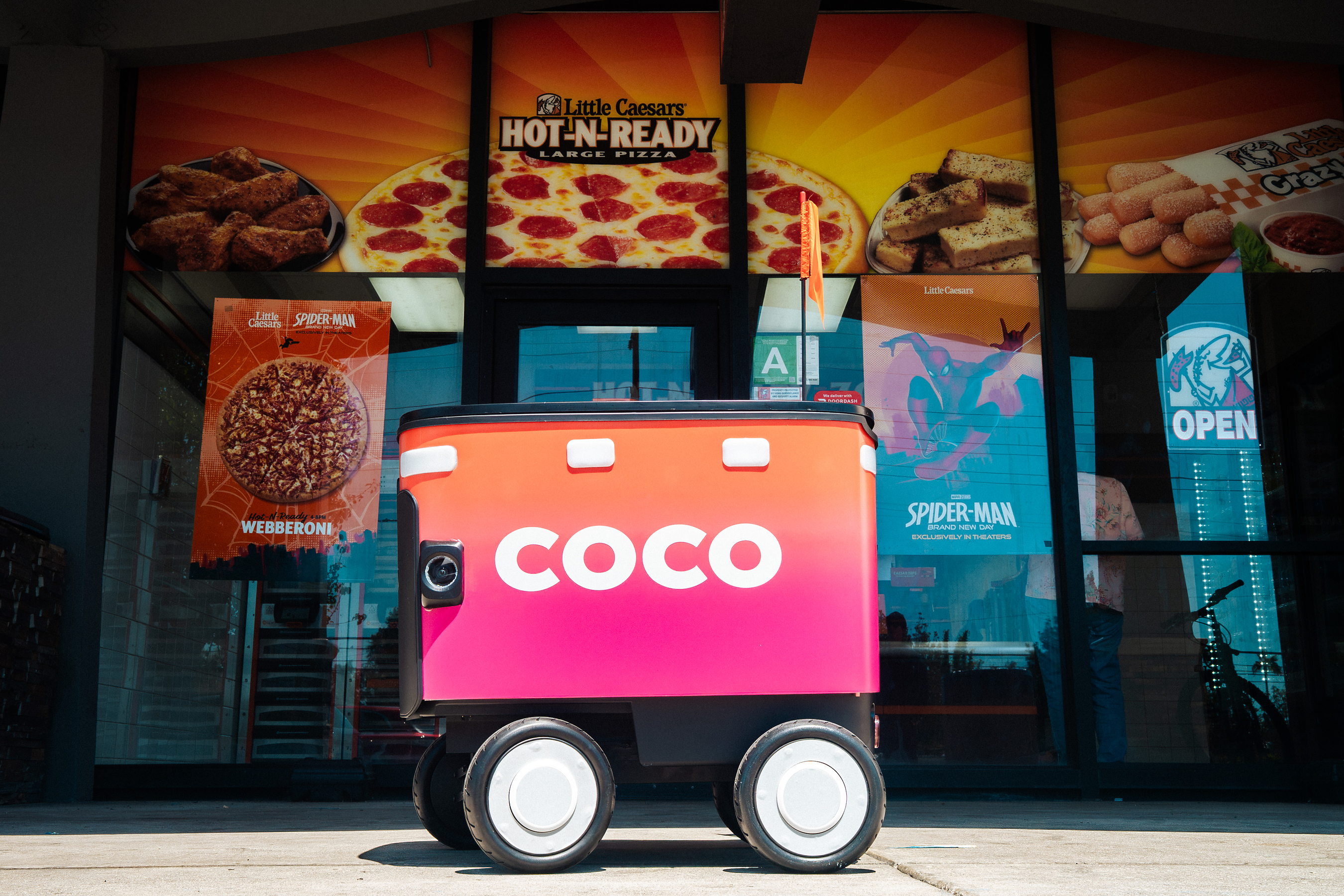
Little Caesars is deploying Coco Robotics autonomous sidewalk robots to fulfill pizza deliveries across participating locations in Los Angeles, Chicago, and Miami, with an expansion to downtown San Jose on the way. Customers ordering through DoorDash or Uber Eats at eligible locations may have their HOT-N-READY® pizzas handed off to a Coco robot for the final leg of the trip — no driver, no added steps for store staff.
The integration works directly within DoorDash and Uber Eats' existing order flows, meaning in-store teams see no change to their current process. Once an order is ready, it moves from the kitchen to the curb, where a Coco robot completes the delivery. For operators juggling peak-period volume, that curb handoff matters: it removes the friction of coordinating with third-party drivers at the counter and reduces lobby congestion during busy shifts.
Why Operators Should Watch This
"By integrating Coco's autonomous robots, we can deliver hot, delicious pizza in record time to more customers," said Trish Heusel, VP of Innovation at Little Caesars. "Automating deliveries also reduces congestion in our stores and helps get orders out faster during peak periods." The comment points to a broader pressure point in restaurant delivery operations — driver wait times and in-store crowding during rushes remain persistent pain points for quick-service operators relying heavily on third-party platforms.
Coco, founded in 2020, says its fleet has completed more than 500,000 zero-emission deliveries across the U.S. and Europe. The company positions its AI-driven robots as continuously learning from real-world mileage, which it argues enables faster deployment in new markets. The Little Caesars rollout is the platform's most prominent QSR partnership to date and earned the chain two 2026 Franchise Innovation Awards — Innovator of the Year for Operations & Technology and Most Innovative Use of Technology.
Scale and Sustainability
For a chain with restaurants in all 50 U.S. states and 31 countries, the pilot's multi-city footprint signals that Little Caesars is evaluating robot delivery as a scalable operational tool rather than a one-location experiment. The zero-emission angle also aligns with growing sustainability expectations in foodservice, where delivery's carbon footprint has drawn increasing scrutiny from both regulators and consumers. Melissa Fahs, VP of Enterprise at Coco Robotics, called the partnership a demonstration of "how autonomous deliveries can enhance the guest experience at scale, making ultra-fast, sustainable delivery a reality for millions of pizza lovers."
For QSR operators monitoring last-mile logistics, the key variable to watch is how seamlessly robot fulfillment integrates with existing third-party platform infrastructure — and whether the speed and congestion benefits hold up as volume scales across more locations.
Written by Michael Politz, Author of Guide to Restaurant Success: The Proven Process for Starting Any Restaurant Business From Scratch to Success (ISBN: 978-1-119-66896-1), Founder of Food & Beverage Magazine, the leading online magazine and resource in the industry. Designer of the Bluetooth logo and recognized in Entrepreneur Magazine's "Top 40 Under 40" for founding American Wholesale Floral, Politz is also the Co-founder of the Proof Awards and the CPG Awards and a partner in numerous consumer brands across the food and beverage sector.