An eight-seat counter restaurant tucked inside Kanazawa's Nishi Chaya geisha district is preparing to shift its menu entirely around live snow crab when Ishikawa Prefecture's winter fishing season opens in early November. Canisienne Kanazawa — known locally as Kanijennu Kanazawa — will run its Winter Crab Feast Course through the end of December, priced at ¥49,000 (approximately US$310, tax included), with a 10% service charge applied separately.
The Counter Experience
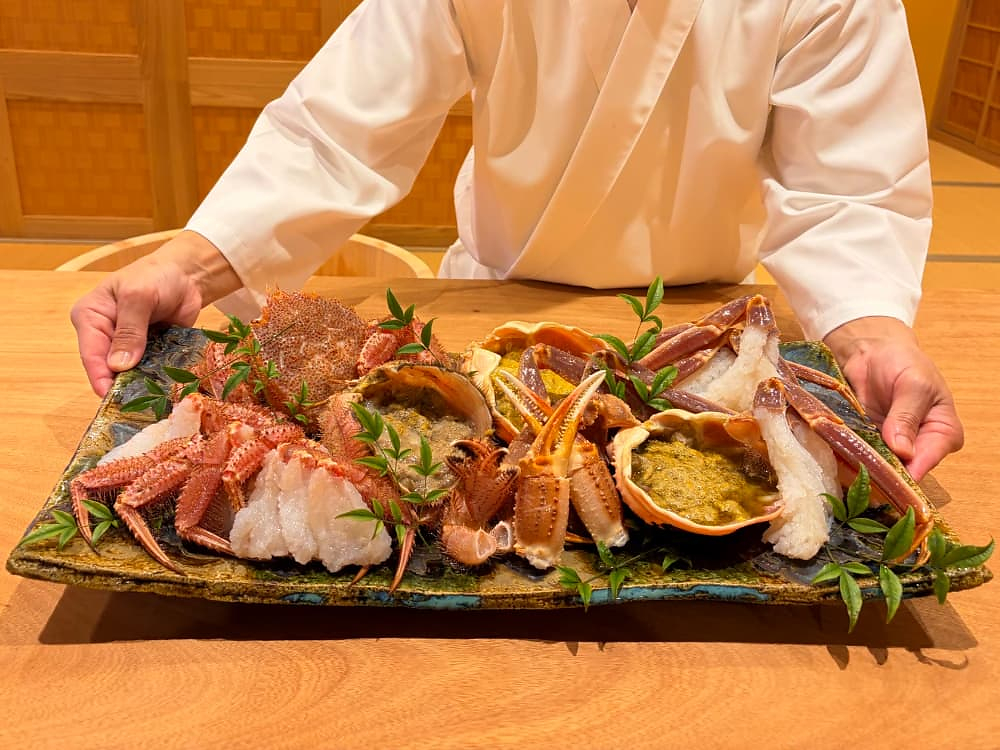
The restaurant's format is deliberately intimate: chefs break down live crab in full view of diners, producing sashimi, charcoal-grilled preparations, and shabu-shabu in rapid succession across roughly a two-hour sitting. The winter course features horsehair crab sourced from the Noto Peninsula, kōbako-gani (female snow crab), and live Kanō-gani — the regional brand name for male snow crab landed in Ishikawa. Ahead of the winter launch, Kanazawa Biyori sampled the restaurant's autumn tasting course, which paired horsehair crab with red snow crab and incorporated local ingredients including black abalone from Wajima, whelk, and nodoguro (blackthroat seaperch) from Noto.
The counter-theater model — where preparation technique is itself part of the dining value proposition — mirrors trends gaining traction in omakase and chef's-counter formats across high-end hospitality markets globally. At Canisienne Kanazawa, crab sashimi is chilled in cold water until the meat opens petal-like before service; grilled portions are finished over charcoal with a ponzu sauce blended with kani miso (tomalley); and shabu-shabu is timed to preserve the natural sweetness of each species. The kitchen also incorporates matsutake mushroom broth into late-course rice dishes, tying regional seasonality tightly to the protein.
Cultural Pairing Option
For operators and hospitality buyers interested in culturally differentiated private dining, the restaurant offers a separate tier: a Winter Crab Feast with a live performance by Kanazawa geiko (geisha), available for private parties of six to eight guests at a minimum spend of ¥600,000 (approximately US$3,800, tax included). That package is not bookable online and requires direct inquiry — a positioning choice that effectively creates two distinct revenue channels within a single small-footprint venue.
The broader context matters for fine-dining and destination hospitality coverage: Kanazawa has emerged as one of Japan's most closely watched culinary destinations since the Hokuriku Shinkansen extension improved access from Tokyo. The city's three geisha districts — Higashi Chaya, Kazuemachi, and Nishi Chaya — have anchored a premium food-and-culture tourism narrative that regional operators are increasingly building around. Canisienne Kanazawa's model, layering a legally protected regional seafood brand (Kanō-gani), an ultra-limited seat count, and a traditional performance art into a single seasonal offering, represents a template that hospitality developers in other regional Japanese markets may find instructive.
Course contents are subject to change based on fishing season and daily availability. Reservations for the standard course are handled through TableCheck; the restaurant operates lunch service from noon and dinner from 6 p.m.
Written by Michael Politz, Author of Guide to Restaurant Success: The Proven Process for Starting Any Restaurant Business From Scratch to Success (ISBN: 978-1-119-66896-1), Founder of Food & Beverage Magazine, the leading online magazine and resource in the industry. Designer of the Bluetooth logo and recognized in Entrepreneur Magazine's "Top 40 Under 40" for founding American Wholesale Floral, Politz is also the Co-founder of the Proof Awards and the CPG Awards and a partner in numerous consumer brands across the food and beverage sector.