Baby food containing lead levels above FDA action limits was still being sold on Harris Teeter shelves in the Washington, DC and Baltimore-area suburbs as recently as this month, according to a new investigation by the Center for Responsible Food Business (CRFB) — even though Maryland and Virginia enacted laws in January 2026 explicitly prohibiting such sales.
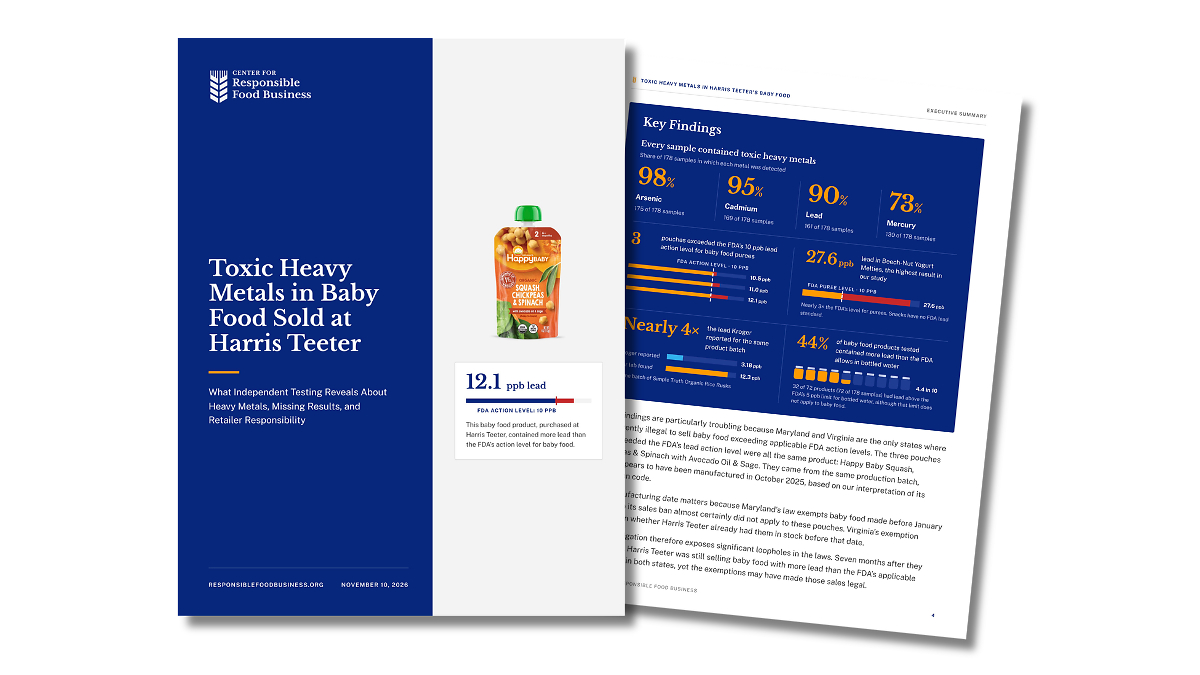
An accredited laboratory purchased and tested 178 samples representing 72 baby food products from 11 Harris Teeter locations. Three pouches of Happy Baby Squash, Chickpeas & Spinach registered lead concentrations of 10.5, 11.0, and 12.1 parts per billion (ppb), each exceeding the FDA's 10 ppb action level for that product category. Beyond lead, the findings were broad: toxic heavy metals — lead, cadmium, arsenic, and/or mercury — appeared in every single sample tested, with 99% of samples containing two or more of those metals.
What the Numbers Show
The scope of contamination extends well beyond the headline lead findings. Nearly half of all samples contained more lead than the FDA permits in bottled water. Some products exceeded California's daily lead exposure benchmark in a single serving. Perhaps most striking for retail operators: Kroger's own private-label baby snacks contained substantially more lead than the company had publicly reported — more than triple its reported levels, according to CRFB.
The organization also flagged missing test results as a potential compliance issue, raising concerns that some products may not have undergone the testing now required under state law. Maryland's Rudy's Law, which mandates heavy-metal testing for baby food sold in the state, was named after a child who suffered lead poisoning from contaminated baby food products.
Implications for Grocery Retailers
For supermarket and grocery operators, the investigation underscores a rapidly shifting regulatory landscape around food safety and retail food compliance. Maryland and Virginia are the first states to ban retail sales of baby food exceeding FDA action levels, and both states include exemptions for older inventory — a loophole CRFB is urging regulators to close. Retailers in other states should anticipate similar legislation as the issue gains political traction.
Taylor Warren, CRFB president, called on Harris Teeter and parent company Kroger to investigate the affected products, strengthen safety standards across their baby food assortment, and make testing results accessible to consumers. The organization is simultaneously pressing Maryland and Virginia regulators to enforce existing law and eliminate exemptions that keep non-compliant products on shelves.
The findings arrive at a moment when food safety scrutiny across the grocery and foodservice supply chain is intensifying. Operators sourcing private-label or store-brand products face particular exposure, as the Kroger data suggests that manufacturer-reported test results may not always reflect what ends up on retail shelves. Industry professionals following food safety and supply chain transparency will want to review CRFB's full methodology, which is published at the organization's website alongside complete laboratory results.
The full report, Toxic Heavy Metals in Harris Teeter's Baby Food, is available at responsiblefoodbusiness.org.
Written by Michael Politz, Author of Guide to Restaurant Success: The Proven Process for Starting Any Restaurant Business From Scratch to Success (ISBN: 978-1-119-66896-1), Founder of Food & Beverage Magazine, the leading online magazine and resource in the industry. Designer of the Bluetooth logo and recognized in Entrepreneur Magazine's "Top 40 Under 40" for founding American Wholesale Floral, Politz is also the Co-founder of the Proof Awards and the CPG Awards and a partner in numerous consumer brands across the food and beverage sector.