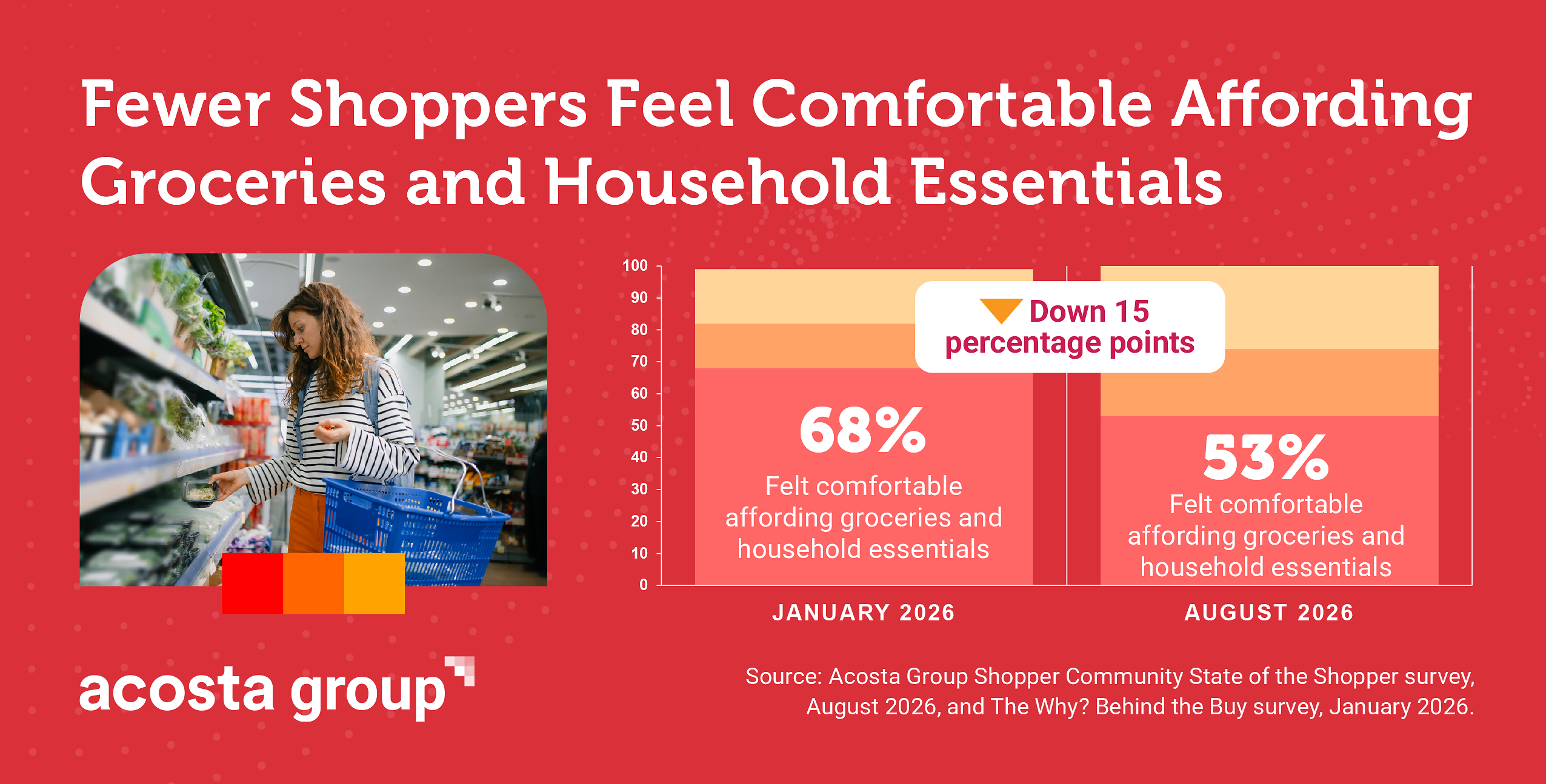
Only 53% of shoppers felt comfortable affording groceries and household essentials as of August 2026, down sharply from 68% in January, according to Acosta Group's second Affordability Tracker report. The 15-percentage-point slide came even as grocery purchasing power improved modestly — a disconnect that carries direct implications for how brands and operators frame value to increasingly cautious consumers.
The Basket Numbers
For the four weeks ending September 5, 2026, Acosta Group's Typical Stock-Up Trip — an 84-item basket of commonly purchased grocery and household essentials — cost $366.42, a 3.5% increase year over year. Median hourly earnings rose roughly 4.6% in the second quarter, trimming the work time required to buy that basket from 11.84 hours to 11.72 hours, a gain of about seven minutes. That incremental improvement, however, lands against a backdrop of cumulative shelf-price inflation: the same basket now costs approximately 31% more than it did in the comparable period of 2020, making small purchasing-power gains nearly imperceptible to most households.
The share of shoppers who said they felt uncomfortable affording groceries and household essentials climbed from 17% in January to 26% in August, as housing, insurance, and health-care costs continued competing for the same paychecks. "The affordability recovery has reached a point where small gains in purchasing power are offering little breathing room for households," said Colin Stewart, executive vice president of business intelligence at Acosta Group. "Shoppers are weighing a grocery purchase against everything else their income needs to cover, and the habits they developed during the inflation surge remain practical ways to manage that pressure."
What Shoppers Are Actually Doing
Acosta Group's August shopper research shows those habits are well entrenched. Looking back over the prior six months, 43% of shoppers said elevated prices led them to cut spending on nonessentials, and another 43% spent more time searching for deals. Thirty-eight percent switched to store brands more often, and 35% migrated to lower-price retailers. The forward-looking sentiment is equally cautious: only 47% felt confident they could afford grocery and household needs over the next 12 months, while 34% expressed worry.
For foodservice and retail operators, the data reinforces a pattern that restaurant and grocery industry analysts have tracked since the post-pandemic inflation peak — consumers are not snapping back to pre-inflation behavior even when wages nominally improve. Stewart noted that brands and retailers should focus on making value easier to recognize, with clear communication around quality, pack size, and the practical benefits that justify a purchase rather than competing on lowest price alone.
Implications for Operators and Brands
The tracker pairs NIQ Discover basket-pricing data with U.S. Bureau of Labor Statistics earnings figures to calculate the work hours needed to complete a standard stock-up trip, providing a national purchasing-power benchmark rather than a household-level financial assessment. The methodology offers a useful lens for CPG brands and retail buyers deciding how to position promotional strategy heading into the 2027 planning cycle.
For foodservice operators, the shopper sentiment mirrored in this grocery and consumer spending research matters beyond the supermarket aisle. When households feel financial pressure at the shelf, discretionary restaurant visits face similar scrutiny. Operators who can clearly signal portion value, price transparency, and deal accessibility — whether through loyalty programs, bundled meals, or limited-time pricing — stand to capture consumers still actively managing every dollar of essential spending.
Written by Michael Politz, Author of Guide to Restaurant Success: The Proven Process for Starting Any Restaurant Business From Scratch to Success (ISBN: 978-1-119-66896-1), Founder of Food & Beverage Magazine, the leading online magazine and resource in the industry. Designer of the Bluetooth logo and recognized in Entrepreneur Magazine's "Top 40 Under 40" for founding American Wholesale Floral, Politz is also the Co-founder of the Proof Awards and the CPG Awards and a partner in numerous consumer brands across the food and beverage sector.