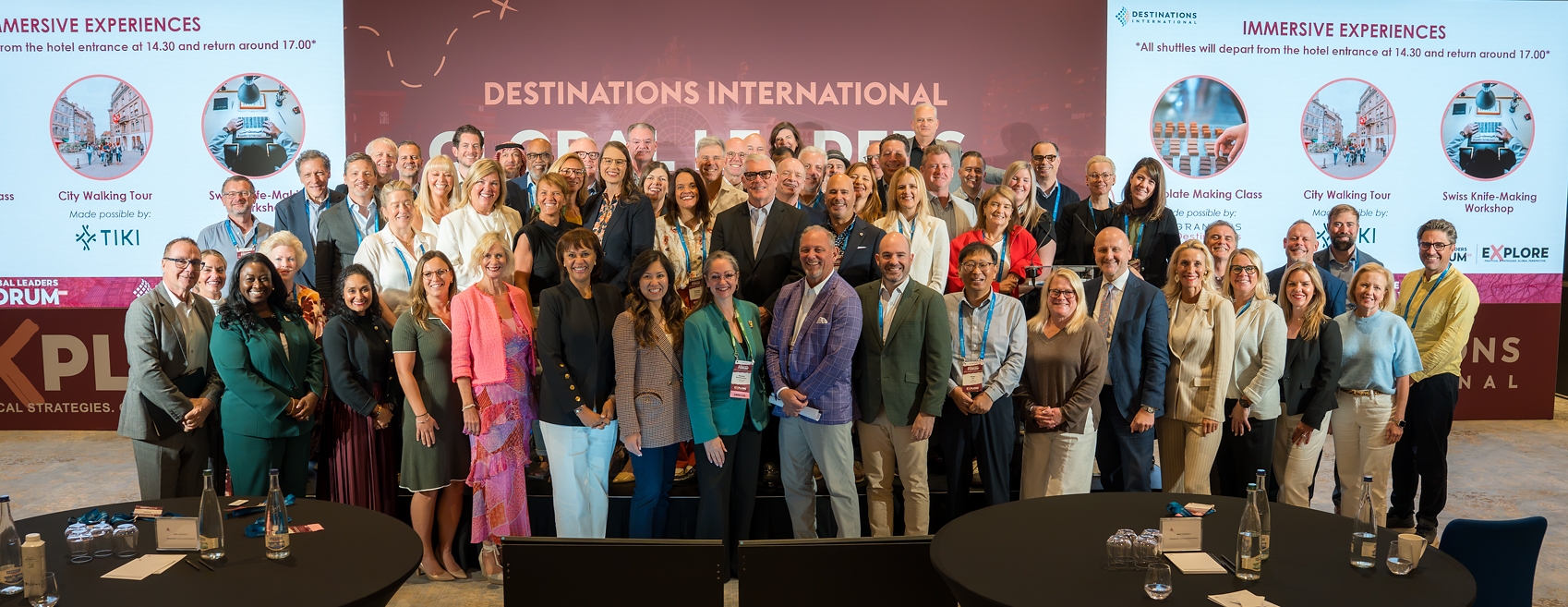
Destination executives representing more than 52 countries wrapped up Destinations International's 2026 Global Leaders Forum in Geneva last week, walking away with a shared conviction: measuring success by visitor arrivals alone no longer captures what destination organizations actually do — or what they must become.
The invitation-only gathering, held September 22–24 at Geneva with support from the Geneva Tourism & Conventions Foundation, brought senior destination management executives together for three days of frank discussion on technology disruption, geopolitical risk, talent flows, and the expanding role of convention and visitors bureaus in shaping community economies. For hospitality and foodservice operators whose revenues are directly tied to destination health, the strategic shift discussed in Geneva carries real business implications.
Beyond Room Nights
The Forum's dominant theme was reframing how destinations — and their industry partners — define value. Traditional benchmarks such as room nights, visitor arrivals, and direct spend remain relevant, but Forum participants argued that destination organizations must increasingly demonstrate impact across investment attraction, talent recruitment, and quality-of-life outcomes for residents. That broader mandate repositions CVBs and tourism boards as economic development partners rather than simple marketing arms, a change that affects how hotels, restaurants, and event venues engage with those organizations and position themselves within destination narratives.
Artificial intelligence emerged as another critical pressure point. As AI reshapes how travelers discover and evaluate places — from itinerary planning to restaurant recommendations — destination organizations were urged to actively manage how their communities are represented across emerging digital platforms. For restaurant and hospitality operators, that means the AI-driven "front door" of a destination may surface or suppress individual businesses based on data quality and platform presence, raising the stakes for digital content strategies.
Resilience Over Restoration
Participants also challenged a common instinct in the travel and hospitality sector: the desire to return to pre-disruption baselines. The Forum's conclusion was pointed — resilience means adaptation, not restoration. Destinations that use disruption as a catalyst for agility and innovation will outperform those that simply wait to recover. That framing echoes the pressure that food and beverage operators faced through recent supply-chain and labor disruptions, where the businesses that restructured operations rather than waited out the storm fared better long-term.
Vancouver offered a concrete case study in creative destination strategy. Destination Vancouver, fresh from co-hosting 2026 FIFA World Cup matches, repurposed World Cup goal nets as hammocks, tying sports fandom to the city's "urban rejuvenation" brand positioning. Royce Chwin, president and CEO of Destination Vancouver, presented one of the hammocks to Adrien Genier, CEO of the Geneva Tourism & Conventions Foundation — a gesture that reinforced how major events can generate identity assets well beyond their run dates. For hospitality operators tracking event-driven demand, the Vancouver model illustrates how a host city's post-event narrative can sustain visitation and F&B spending long after the final whistle.
What Comes Next
"No destination has all the answers," said Gretchen Hall, chief operating officer at Destinations International. "Geneva reminded us that some of the best ideas emerge when we bring different experiences and perspectives together."
The Forum included a site visit to CERN, the European Organization for Nuclear Research, where delegates drew parallels between the laboratory's global, trust-based collaboration model and the cross-border cooperation now required of destination leaders. Don Welsh, president and CEO of Destinations International, noted that destination organizations have a clear opportunity to lead change — but only by thinking more broadly about the stakeholders they serve and the value they create.
The third annual Global Leaders Forum is set for Vancouver, British Columbia, in 2027, with dates to be confirmed. The series, which launched in Dublin in 2025, reflects the association's growth as a connector of destination professionals across more than 800 destinations worldwide.
Written by Michael Politz, Author of Guide to Restaurant Success: The Proven Process for Starting Any Restaurant Business From Scratch to Success (ISBN: 978-1-119-66896-1), Founder of Food & Beverage Magazine, the leading online magazine and resource in the industry. Designer of the Bluetooth logo and recognized in Entrepreneur Magazine's "Top 40 Under 40" for founding American Wholesale Floral, Politz is also the Co-founder of the Proof Awards and the CPG Awards and a partner in numerous consumer brands across the food and beverage sector.