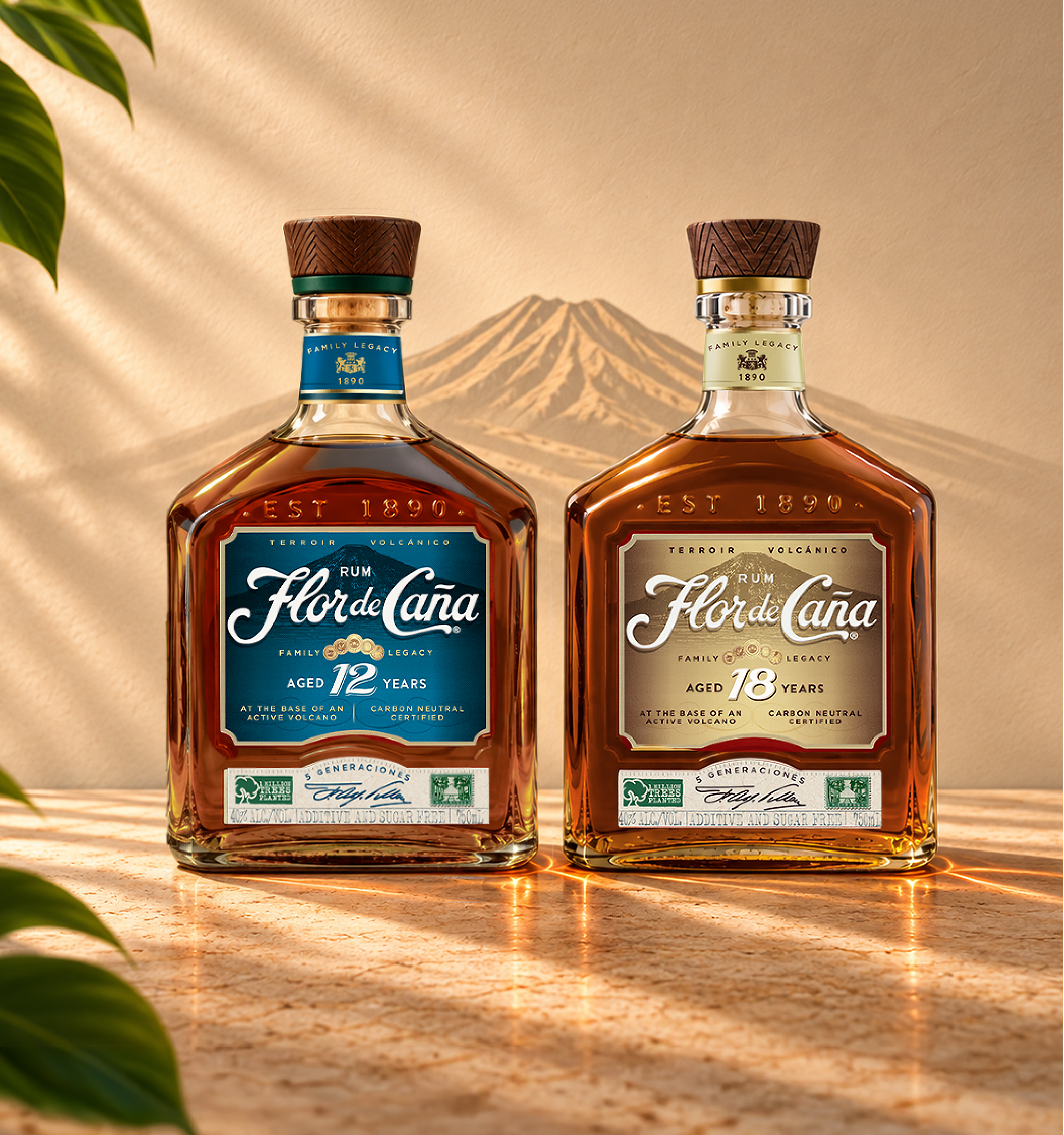
Flor de Caña has won the 'Net Zero Strategy of the Year' Stevie® Award at the 2026 International Business Awards, adding a cross-industry business honor to a sustainability portfolio that already spans Carbon Neutral certification, 100% renewable-energy distillation, and the planting of more than one million trees.
Why Operators Should Note This
For bar programs and beverage directors building menus around sustainability storytelling, the recognition carries practical weight. The Stevie Awards are judged by business leaders across sectors — not spirits-industry insiders — meaning Flor de Caña cleared an unusually broad competitive field to claim the category. That cross-industry validation can translate directly into on-menu and staff-training narratives for operators who already lean on the brand's backstory: a family estate dating to 1890, production at the base of Nicaragua's San Cristóbal volcano, and natural aging in American white oak barrels with no added sugar or artificial ingredients.
Sustainability credentials have become a measurable purchase driver in premium spirits, particularly among younger on-premise consumers. For restaurateurs and bar operators, stocking brands that carry verifiable third-party certifications — rather than self-reported green claims — reduces reputational risk and strengthens positioning in an increasingly scrutinized category. Our beverage industry analysis has tracked this shift across wine, beer, and spirits over the past several years.
The Bigger Sustainability Picture
The Stevie win sits alongside a roster of prior honors Flor de Caña has accumulated internationally, including recognition as the "World's Most Sustainable Rum Brand" in the United States, an "Ethical Award" in the United Kingdom, and a "Sustainable Spirits Producer" designation in France. Taken together, those distinctions reflect a consistent pattern of third-party validation rather than a single campaign-driven moment.
Stevie Awards President Maggie Miller noted that the 2026 winners "demonstrated exceptional innovation, leadership, resilience, and results in a highly competitive global field" — language that underscores the award's intent to benchmark against business performance broadly, not just environmental messaging.
For the spirits segment specifically, the honor arrives as the rum category continues its premiumization arc. Restaurant hospitality coverage has documented how premium and super-premium spirits increasingly depend on provenance and purpose-driven narratives to justify price points on cocktail menus. A globally recognized net-zero strategy gives rum an on-trend sustainability story that has historically been dominated by wine and craft beer.
Flor de Caña's production model — renewable energy throughout distillation, volcano-base aging, and a reforestation commitment exceeding one million trees — is built into the product itself rather than bolted on as marketing. That structural authenticity is likely to remain a differentiator as regulators and consumers in key export markets push for more rigorous environmental accountability across the beverage alcohol supply chain.
Written by Michael Politz, Author of Guide to Restaurant Success: The Proven Process for Starting Any Restaurant Business From Scratch to Success (ISBN: 978-1-119-66896-1), Founder of Food & Beverage Magazine, the leading online magazine and resource in the industry. Designer of the Bluetooth logo and recognized in Entrepreneur Magazine's "Top 40 Under 40" for founding American Wholesale Floral, Politz is also the Co-founder of the Proof Awards and the CPG Awards and a partner in numerous consumer brands across the food and beverage sector.