
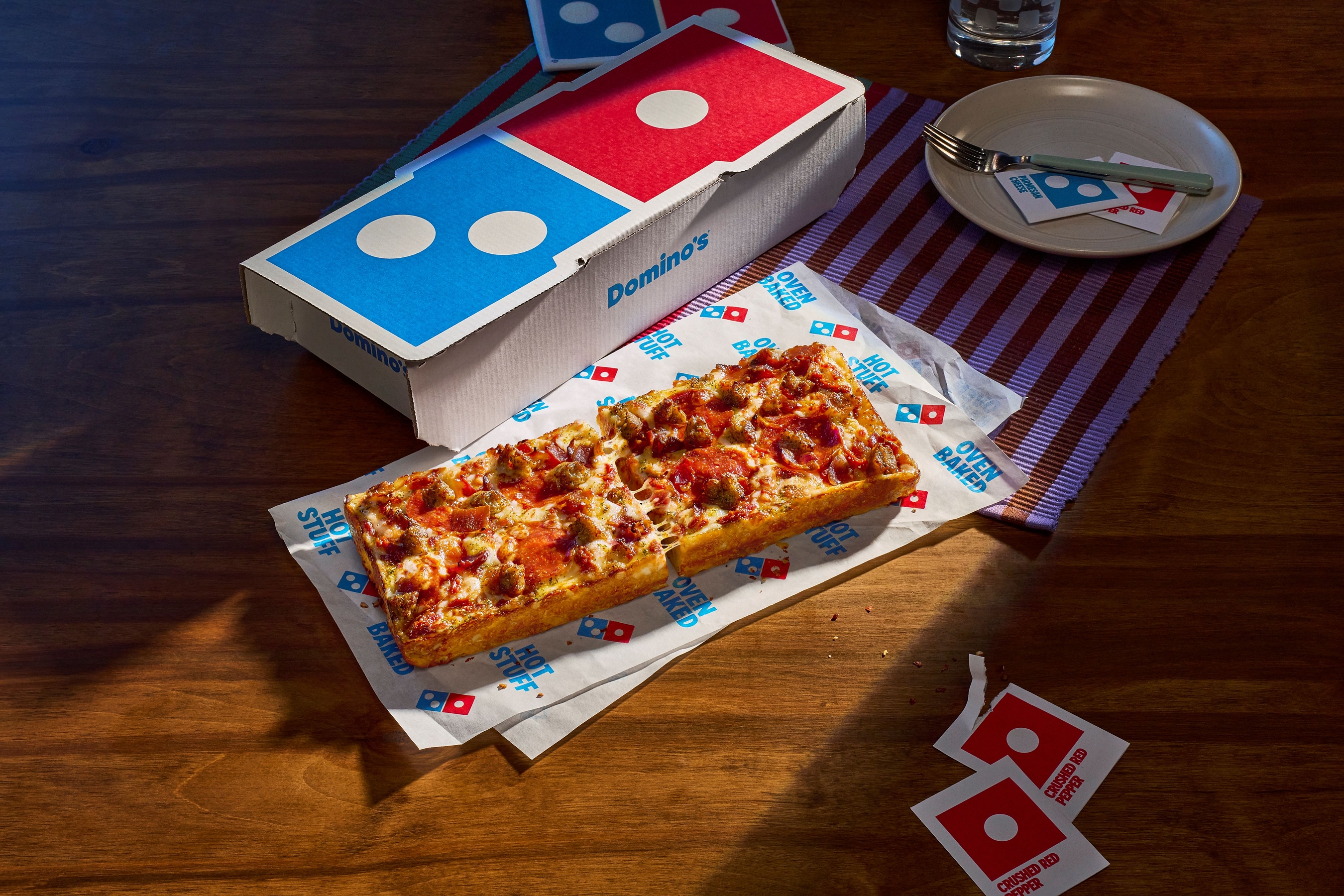
Domino's Pizza is rolling out a personal-size Detroit-style pizza on Aug. 31, marking the chain's first product to carry the brand's own name. Called the Domino, the single-serve pie is shaped like the company's iconic domino-tile logo, cut into two slices, and pitched as a direct answer to the customization friction that comes with traditional shared pizza.
What's in the Pie
The Domino is handmade with a buttery-flavored pan dough encrusted with real Parmesan cheese and baked in a rectangular pan to produce the crispy, caramelized edge characteristic of the Detroit style. Each order includes two layers of cheese, the customer's choice of sauce, and up to three toppings, finished with Domino's signature garlic seasoning drizzle. The format mirrors a growing operator push toward individually portioned menu items that reduce friction during group ordering — a persistent pain point flagged across the full-service and quick-service segments alike.
"The Domino fills a gap in our portfolio," said Joe Jordan, chief operating officer, president of Domino's U.S., and incoming CEO. "When everyone wants something different, traditional pizza falls short. The Domino lets every person build the exact pizza they want."
Operator and Menu Implications
For Domino's franchise system — which accounts for 99% of the chain's more than 22,500 global locations — the new SKU slots into the existing Mix and Match Deal at $6.99 per item when customers choose any two or more menu items, including a two-topping Domino. That price point positions the product competitively within the fast-casual personal-pizza segment while giving franchisees a lower ticket entry that can still pair with drinks, sides, or a second Domino in a single transaction.
Independent consumer testing rated the Domino among the most well-received products the chain has introduced, according to the company. Domino's is framing the item around three specific dayparts and occasions: weekday lunch, late-night snacking, and family pizza night when household members can't agree on toppings. That last use case is particularly relevant for operators thinking about group-dining order dynamics, where table-level customization has increasingly driven guests toward build-your-own formats.
Context and Competitive Landscape
Detroit-style pizza has moved steadily from regional specialty to mainstream QSR battleground over the past several years. Little Caesars — also Michigan-based — has featured a Detroit-style offering for years, while Pizza Hut ran a Detroit-style pan pizza nationally. Domino's entry into the format with a personal size rather than a shareable pie represents a meaningful category distinction: the brand is competing less on regional authenticity and more on convenience and individualization.
With global retail sales surpassing $20.6 billion in the trailing four quarters ended June 14, 2026, Domino's has the scale to make the Domino a significant volume driver quickly. More than 85% of U.S. retail sales in 2025 ran through digital channels, which means the personalization story — every diner building their own order — aligns naturally with how the majority of customers already interact with the brand. For industry observers tracking pizza segment innovation, the Domino's move underscores how single-serve formats are no longer niche: they're becoming a core menu architecture tool for high-frequency chains.
Written by Michael Politz, Author of Guide to Restaurant Success: The Proven Process for Starting Any Restaurant Business From Scratch to Success (ISBN: 978-1-119-66896-1), Founder of Food & Beverage Magazine, the leading online magazine and resource in the industry. Designer of the Bluetooth logo and recognized in Entrepreneur Magazine's "Top 40 Under 40" for founding American Wholesale Floral, Politz is also the Co-founder of the Proof Awards and the CPG Awards and a partner in numerous consumer brands across the food and beverage sector.
