Craft tequila brands grew retail dollar sales 18.6% in the 52 weeks ending Aug. 29, 2026, even as total category dollar sales fell 3.5% to $5.29 billion, according to a new 41-page market study from The Tequila Report. The report, titled "Tequila's 10% Problem" and sponsored by PKGD Group, pairs retail scan data with a national survey of 1,000 adults who drink tequila at least monthly.
The volume picture tells a different story: shoppers bought a record 290.5 million bottles, up 5.9%, but average spending per bottle dropped from $21.37 to $18.21 over two years — a decline of nearly 15%. Brand price cuts account for roughly one-fifth of that decrease; the rest reflects consumers trading down to smaller formats and less expensive labels.
Craft Carries the Category
The 181 brands the report classifies as craft — defined by the absence of industrial diffusers, additive-free declarations, and annual retail volume below 200,000 nine-liter cases — added approximately $167 million in retail sales over two years while the rest of the category lost roughly $92 million. That means craft accounted for more than all of tequila's net dollar growth despite representing only 9.7% of retail scan dollars. The report's title reflects precisely that tension: a fast-growing segment that still hasn't cracked 10% of the market.
"Craft tequila does not need more brands explaining why they are better," said Dave Wiley, research director at The Tequila Report. "It needs more drinkers to be able to name the one they want next."
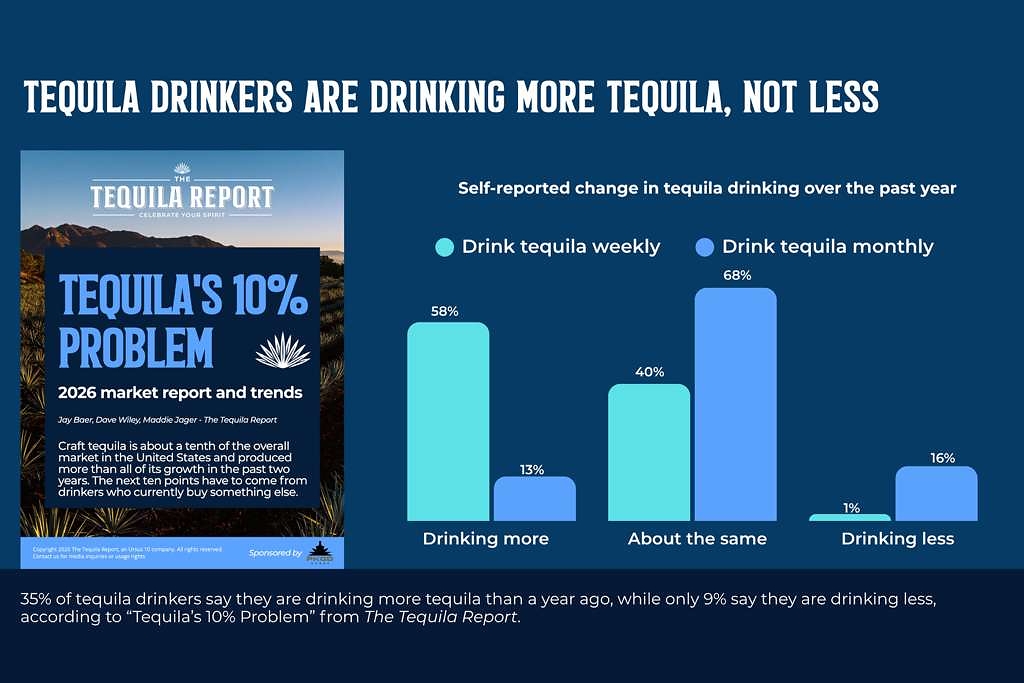
For on-premise operators, the data carry direct implications. Thirty-five percent of monthly tequila drinkers say they are drinking more than a year ago versus only 9% who say less — a net-positive consumption trend that bucks the broader alcohol category's headwinds. Gallup's 2026 poll found only 54% of U.S. adults say they drink alcohol at all, matching a record low set in 2025. Among tequila drinkers ages 21–29, 53% report drinking more year over year, and 73% in that cohort regularly take shots — a detail with clear menu and back-bar implications.
What Moves the Purchase
Brand familiarity ranked first among 12 purchase attributes tested, cited as important by 72% of respondents. Price followed at 64%, positive online information at 56%, and additive-free claims at 55% — with three-quarters of respondents already aware of the additive-free concept, a sign the trade conversation has reached mainstream drinkers.
For bar and restaurant operators, the channel-influence data may be the most actionable finding. Friends and family lead purchase influence at 47%, but bartender or server recommendations came in at 32%, well ahead of retail employees at 17% — and ahead of every paid advertising channel tested in the study. Fifty-nine percent of respondents also said they had researched a tequila online before buying it, underscoring the value of staff education and digital visibility together.
Spending on-premise and off skews accessible: 82% of blanco buyers typically spend $50 or less for a 750ml bottle, with a median of $40. Nearly half have purchased a bottle costing $100 or more at some point, but only about one in ten does so regularly.
Consumption Patterns and Competition
Shots nearly match cocktails in frequency: 61% of respondents often or almost always drink tequila as a shot, compared with 64% who drink it in cocktails. Forty percent often or almost always drink it neat. Gender differences are pronounced — women favor cocktails (72% vs. 57% for men) while men lean toward neat pours (47% vs. 32%).
Celebrity ownership proved largely irrelevant to most drinkers: 64% say it doesn't matter at all, though about 31% of drinkers under 40 said it factors in, versus just 5% of those 60 and older.
Perhaps the sharpest competitive signal for hospitality professionals is the cannabis finding. Among the 9% of regular drinkers who report consuming less tequila, 18% say they're substituting cannabis — more than the 11% switching to other spirits, beer, or wine, and the 6% moving to hard seltzer or canned cocktails. "For decades, tequila competed primarily with the bottle next to it on the shelf," said Jay Baer, editor and co-founder of The Tequila Report. "Now it is also competing with entirely different ways people relax and socialize."
For operators building beverage programs around premium spirits, the study suggests that staff recommendations and curated craft selections carry more weight than brand marketing — and that the growing additive-free conversation is already influencing what guests order. Broader context on how spirits trends are reshaping restaurant bar programs continues to evolve as the craft segment outpaces legacy players.
Written by Michael Politz, Author of Guide to Restaurant Success: The Proven Process for Starting Any Restaurant Business From Scratch to Success (ISBN: 978-1-119-66896-1), Founder of Food & Beverage Magazine, the leading online magazine and resource in the industry. Designer of the Bluetooth logo and recognized in Entrepreneur Magazine's "Top 40 Under 40" for founding American Wholesale Floral, Politz is also the Co-founder of the Proof Awards and the CPG Awards and a partner in numerous consumer brands across the food and beverage sector.