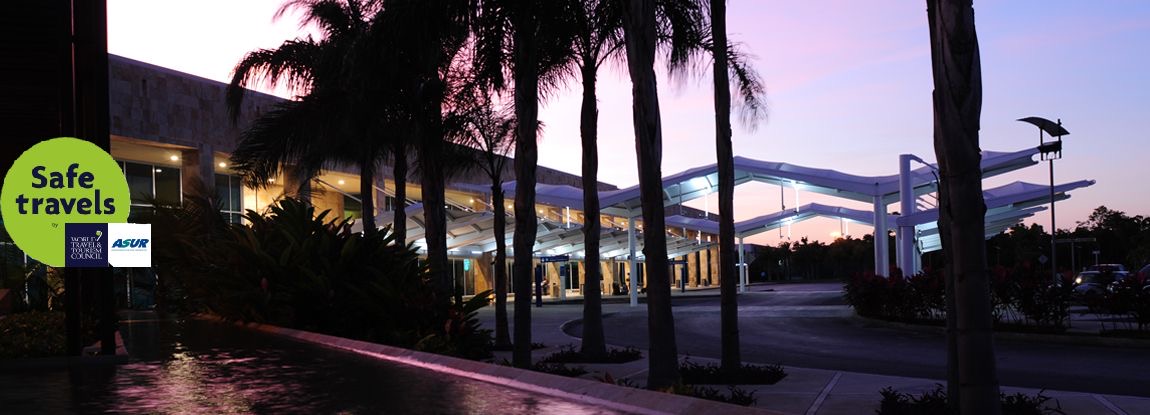
Airport passenger volumes across ASUR's 36-concession Americas network held virtually flat in September 2026, totaling 8.66 million passengers—essentially unchanged from September 2025—but the aggregate figure masks a pronounced regional split that carries real implications for airport foodservice and hospitality operators.
Mexico's Steep Slide
ASUR's nine southeastern Mexican airports collectively shed 6.1% of their passenger base year-on-year, with Cancún (CUN) bearing the brunt. Mexico's dominant resort gateway saw total traffic fall 8.6% to 1.61 million passengers in September, with international arrivals—the highest-spending segment for airport concessionaires—declining a steeper 11.8% to 848,775. Domestic Cancún traffic also contracted 4.8%. For restaurant and retail tenants at Cancún who calibrate staffing, inventory, and promotional budgets to inbound international traveler counts, that double-digit international shortfall is a meaningful headwind. Year-to-date, Cancún is down 5.9% across all traffic categories, putting full-year foodservice revenue projections under pressure at the airport that represents the single largest volume node in ASUR's Mexican portfolio. Broader declines at Oaxaca (–11.3% total) and Minatitlán (–10.9% total) add to the picture of softening domestic and leisure-driven demand in Mexico.
Bright Spots in Colombia and Puerto Rico
Contrasting sharply with Mexico, ASUR's six Colombian airports posted a 5.7% traffic increase to 1.47 million passengers in September. Montería (MTR) led domestic growth at 23.0%, while Rionegro/Medellín international airport—the network's Colombian hub—gained 4.8% in total traffic to 1.18 million passengers. For airport hospitality operators scouting expansion, Colombia's year-to-date trajectory is equally compelling: total traffic at Colombian airports is up 6.5% through September, with domestic volumes ahead 7.5%.
San Juan's Luis Muñoz Marín International Airport—the only major U.S. airport to complete a public-private partnership under the FAA Pilot Program—returned 3.1% traffic growth in September, reaching 810,085 passengers. Both domestic (up 3.4%) and international (up 1.1%) categories improved, a positive signal for airport hospitality trends at one of the Caribbean's busiest transit hubs.
CPC Acquisition Adds New Markets
September also marked the first full month of operations in Brazil, Costa Rica, Curaçao, and Ecuador following ASUR's completed acquisition of CPC Aeroportos. The newly integrated portfolio contributed approximately 3.9 million passengers in the month. Brazil led in volume, up 2.6% overall, with domestic traffic rising 2.9% to roughly 2.84 million passengers. Quito, Ecuador, gained 1.7% in total traffic, while Costa Rica's San José airport declined 6.1%—mirroring the softness seen across ASUR's Mexican markets.
For foodservice and beverage operators tracking Latin American airport concession opportunities, the CPC integration substantially expands the demand base, even if near-term traffic patterns remain mixed. Standout Brazilian sub-markets include Foz do Iguaçu (up 29.0% in total traffic) and Londrina (up 22.6% domestically), both pointing to underpenetrated secondary airports with growing captive passenger populations.
Written by Michael Politz, Author of Guide to Restaurant Success: The Proven Process for Starting Any Restaurant Business From Scratch to Success (ISBN: 978-1-119-66896-1), Founder of Food & Beverage Magazine, the leading online magazine and resource in the industry. Designer of the Bluetooth logo and recognized in Entrepreneur Magazine's "Top 40 Under 40" for founding American Wholesale Floral, Politz is also the Co-founder of the Proof Awards and the CPG Awards and a partner in numerous consumer brands across the food and beverage sector.