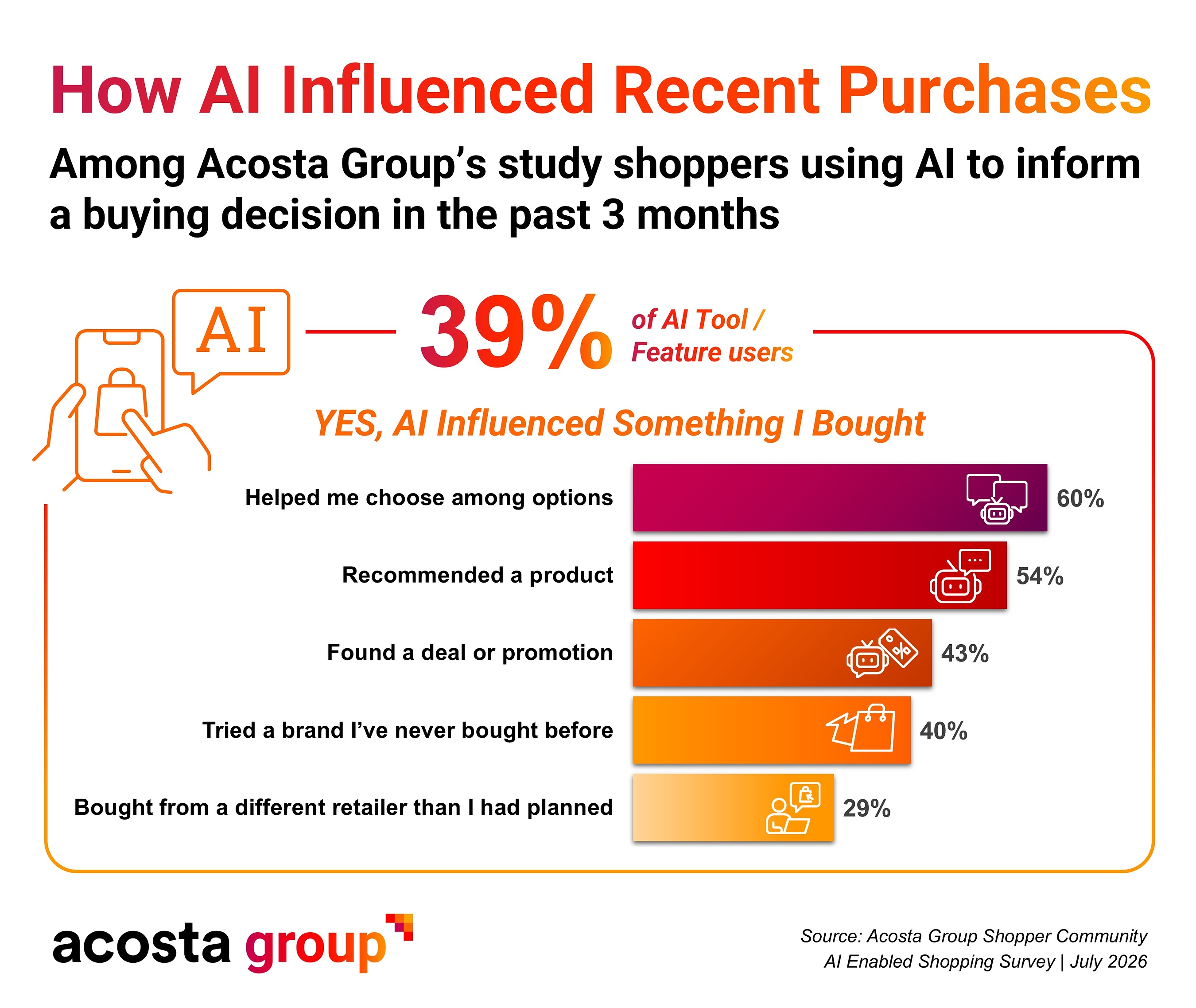
Generative AI has crossed into everyday shopping behavior, with 34% of U.S. shoppers now using AI tools as part of their purchase journey, according to Acosta Group's 2026 AI Shopper Study. Nearly half of Gen Z shoppers reported that AI influenced a buying decision in the past three months — a signal that foodservice brands, grocery retailers, and CPG suppliers can no longer treat AI-driven commerce as a future-state concern.
The study, conducted May 15–21, 2026, surveyed 1,271 U.S. shoppers drawn from Acosta Group's proprietary Shopper Community of more than 40,000 demographically diverse consumers. Grocery and household items ranked among the highest-use categories for AI-assisted shopping, putting the findings squarely on the radar of anyone operating in the food and beverage supply chain.
Adoption Across Generations
Gen Z and Millennial shoppers collectively drive the broadest adoption, with 74% of that combined cohort using generative AI tools. Yet the sharpest growth story may be among older consumers: 45% of Boomers now report using AI, a pace that suggests mainstream saturation is closer than many operators anticipated. ChatGPT and Google Gemini lead as preferred platforms, with Gemini already routinely used by 25% of shoppers during online product searches. Notably, 55% of Gen Z shoppers who use AI tools are doing so while physically in-store — a dynamic with direct implications for retail foodservice and in-store merchandising strategy.
Shoppers cite saving money, comparing products, saving time, and conducting product research as their primary motivations for using AI. For food and beverage brands, that means AI systems are actively mediating purchase decisions at the moment of consideration — and product content accuracy across every digital touchpoint determines whether a brand surfaces in those results.
Trust Is the Friction Point
Despite growing adoption, autonomous purchasing remains limited. Only 22% of Gen AI users trust the technology to make purchases on their behalf, rising to 35% among Millennials. Trust erodes when AI delivers incorrect product information or when shoppers suspect recommendations are influenced by paid placements — a concern that carries particular weight for food brands navigating nutrition claims, allergen data, and ingredient transparency.
"Shoppers' trust in AI for product recommendations has been slow in evolving to allow agents to make purchases on their behalf," said Kathy Risch, SVP Shopper Insights and Thought Leadership for Acosta Group. "Companies that earn shopper trust now will be best positioned as AI becomes a more active purchase agent."
Data privacy is a parallel concern: 48% of all shoppers flagged transparency around how their data is stored and protected. At the same time, younger shoppers already willing to share data are now more open to sharing additional personal details — including preferences, preferred stores, and brands — suggesting that trust, once earned, can unlock richer personalization opportunities for grocers and foodservice operators alike.
What Operators Should Do Now
Brand loyalty retains value in an AI-mediated environment: nearly half of AI-influenced shoppers said they would choose a familiar brand over an unknown option when both are presented by an AI. But 40% reported trying a new brand through AI-driven discovery — a meaningful opening for challenger brands and private-label programs built on strong digital content.
John Carroll, president of Connected Commerce for Acosta Group, recommends brands invest across four areas: retailer readiness (foundational content and data hygiene), shopper understanding (how consumers articulate needs to AI systems), AI discoverability (confirming that AI platforms consistently surface and recommend the product), and ongoing experimentation as consumer behavior continues to evolve.
"Brands' and retailers' future growth will require knowing how products move through the AI commerce stack," Carroll said, "evolving from discovery to decision to transaction."
For operators and brand teams tracking the broader shift in digital foodservice and grocery commerce, the Acosta Group data makes one point difficult to ignore: AI is no longer a channel to prepare for — it is a channel that is already influencing what ends up in shoppers' baskets.
Written by Michael Politz, Author of Guide to Restaurant Success: The Proven Process for Starting Any Restaurant Business From Scratch to Success (ISBN: 978-1-119-66896-1), Founder of Food & Beverage Magazine, the leading online magazine and resource in the industry. Designer of the Bluetooth logo and recognized in Entrepreneur Magazine's "Top 40 Under 40" for founding American Wholesale Floral, Politz is also the Co-founder of the Proof Awards and the CPG Awards and a partner in numerous consumer brands across the food and beverage sector.