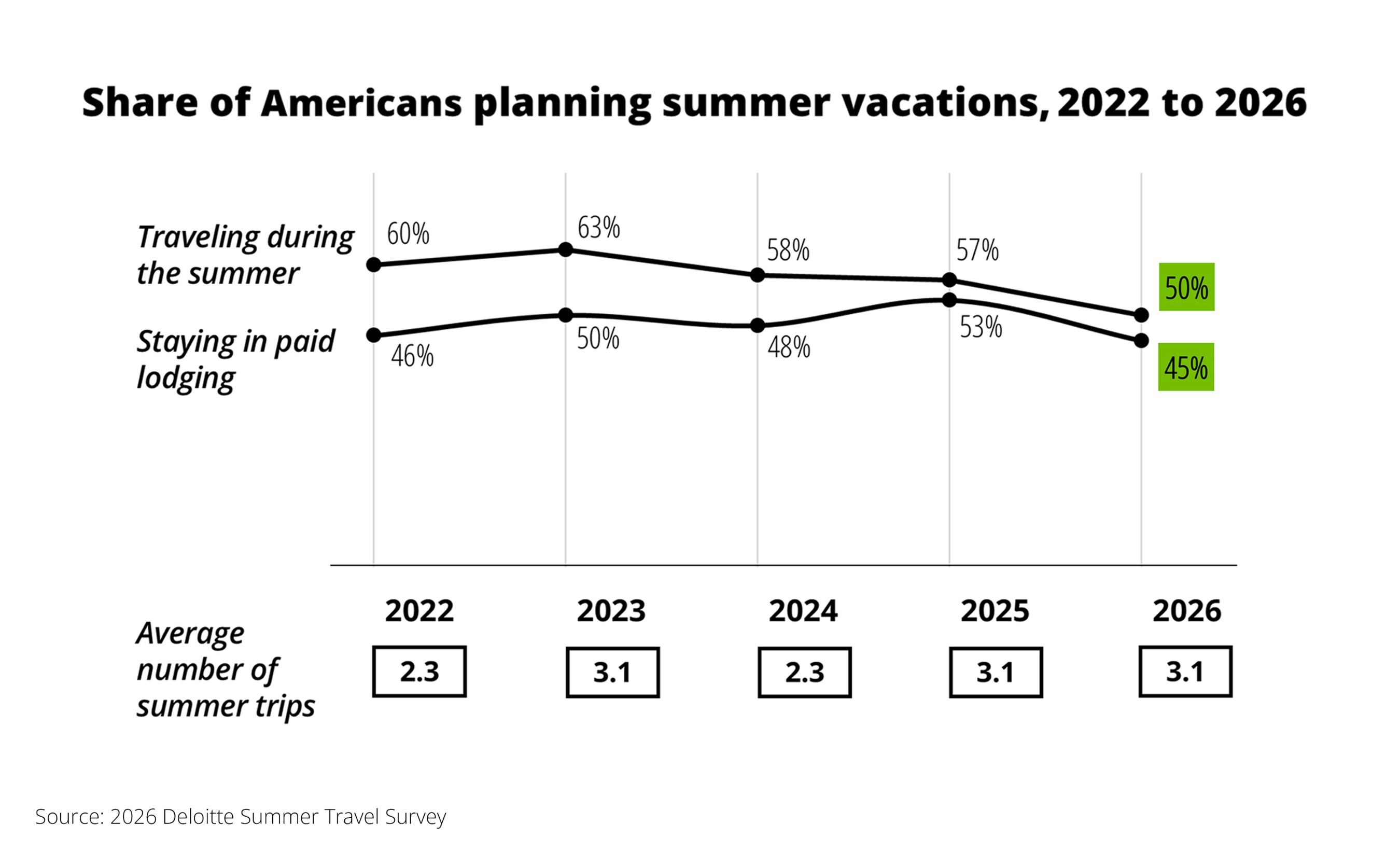
The summer travel season is shrinking in headcount but growing in wallet size, according to Deloitte's 2026 Summer Travel Survey released May 19. Just 45% of Americans plan a summer vacation involving paid lodging—the lowest share in six years—with cost cited as the primary barrier. One-third of non-travelers say travel is simply too expensive (32%), and 35% say they cannot afford it outright.
For hospitality and restaurant operators, the headline number masks a more nuanced opportunity. Travelers who are going somewhere are spending significantly more: the average outlay for the longest summer trip is $4,069, a 17% jump from 2025. Roughly 1 in 4 travelers plan to meaningfully raise their trip budgets compared to last year, driven largely by higher airline ticket prices and rising lodging rates. That willingness to absorb cost increases without trading down on experience is a signal for upscale and full-service restaurant operators that the guests who do arrive may be more receptive to premium menus, experiential dining, and upsells than in recent summers.
Demographic shifts add another layer. Younger travelers are both spending more than last year and traveling more frequently than older cohorts. This group also plans to lean heavily on generative AI and other technology to build itineraries—meaning restaurants and hotels that surface well in AI-assisted discovery tools stand to capture a disproportionate share of bookings and walk-in traffic. Operators should audit how their venues appear in AI-generated recommendations, not just traditional search results.
Perhaps the most operationally relevant finding is the surge in work-and-travel blending. One-third of surveyed travelers (34%) plan to work during their longest summer trip, up sharply from 23% in 2025. For hotels with food and beverage outlets, this is a meaningful shift: the bleisure guest needs reliable Wi-Fi, all-day café service, and grab-and-go options alongside traditional leisure amenities. Properties that have invested in beverage program flexibility and all-day dining are better positioned to monetize that extended on-property dwell time.
The overall picture Deloitte paints is one of a bifurcated market heading into peak season. Budget-constrained consumers are staying home, while committed travelers are prepared to spend at record levels to protect the quality of their experience. For operators, the strategic imperative is clear: compete hard for a smaller but higher-value pool of guests, and make sure every touchpoint—from digital discovery to the check presentation—justifies the premium those guests are already mentally prepared to pay.
Written by Michael Politz, Author of Guide to Restaurant Success: The Proven Process for Starting Any Restaurant Business From Scratch to Success (ISBN: 978-1-119-66896-1), Founder of Food & Beverage Magazine, the leading online magazine and resource in the industry. Designer of the Bluetooth logo and recognized in Entrepreneur Magazine's "Top 40 Under 40" for founding American Wholesale Floral, Politz is also the Co-founder of the Proof Awards and the CPG Awards and a partner in numerous consumer brands across the food and beverage sector.