
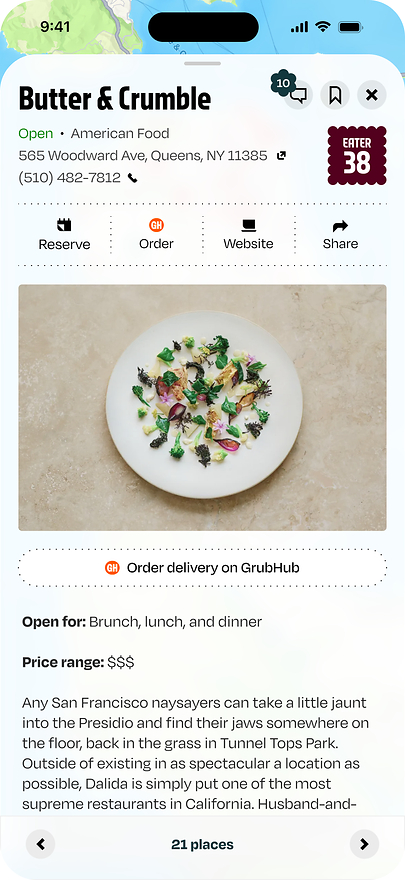
Wonder's Grubhub has struck four new distribution partnerships — with restaurant media brand Eater, social dining app Beli, Amazon's Alexa+, and rent-rewards platform Bilt — that let diners move from food inspiration to checkout without ever leaving those platforms. The integrations, effective June 2026, are designed to shorten the path from discovery to purchase and funnel higher-intent traffic toward the more than 415,000 restaurants in Grubhub's network.
For operators, the practical implication is additional marketing reach at no direct cost to them. Rather than relying solely on diners who open the Grubhub app with intent already formed, restaurants on the platform will now surface inside editorial content on Eater, peer recommendations on Beli, voice queries through Alexa+, and loyalty-driven browsing on Bilt — touchpoints that catch consumers earlier in the decision cycle. McCall Gridley, Head of Grubhub's Growth Partnerships at Wonder, framed the move as meeting diners "where they are already discovering, planning, and ordering their next meal."
Each partner covers a distinct behavioral moment. Eater's editorial integration connects restaurant coverage directly to ordering, letting readers act on a review or roundup immediately. Beli, which lets users rank and share restaurants with friends, adds a social-proof layer to the funnel. Amazon's Alexa+ brings voice-initiated ordering into the mix for connected-home users. Bilt — best known for letting renters earn points on rent payments — introduces a rewards dimension that can make Grubhub orders part of a broader loyalty strategy for consumers already motivated by points accumulation.
The rollout is the latest move by Wonder since it acquired Grubhub from Just Eat Takeaway at the start of 2025 and repositioned the delivery network within a broader "mealtime platform" strategy. Wonder has been vocal about leveraging Grubhub's restaurant density to build new demand rather than compete solely on discounting — a pressure point that has strained delivery economics industry-wide. These integrations fit squarely into that model: incremental order volume generated through third-party audiences rather than margin-eroding promotions.
For restaurant operators evaluating their delivery and third-party platform strategy, the Grubhub expansion illustrates how aggregators are increasingly functioning as distribution infrastructure rather than standalone apps. Operators who already list on Grubhub effectively gain access to each new integration automatically, making it worth auditing menu content, photos, and pricing to ensure listings are optimized for audiences who may encounter them through an Eater article or an Alexa voice query rather than a direct search. Broader food and beverage industry trends suggest that frictionless, context-aware ordering will only accelerate as more media and lifestyle platforms seek to monetize high-intent food content.
Written by Michael Politz, Author of Guide to Restaurant Success: The Proven Process for Starting Any Restaurant Business From Scratch to Success (ISBN: 978-1-119-66896-1), Founder of Food & Beverage Magazine, the leading online magazine and resource in the industry. Designer of the Bluetooth logo and recognized in Entrepreneur Magazine's "Top 40 Under 40" for founding American Wholesale Floral, Politz is also the Co-founder of the Proof Awards and the CPG Awards and a partner in numerous consumer brands across the food and beverage sector.